Explore our diverse range of technical and non-technical events designed to challenge and inspire
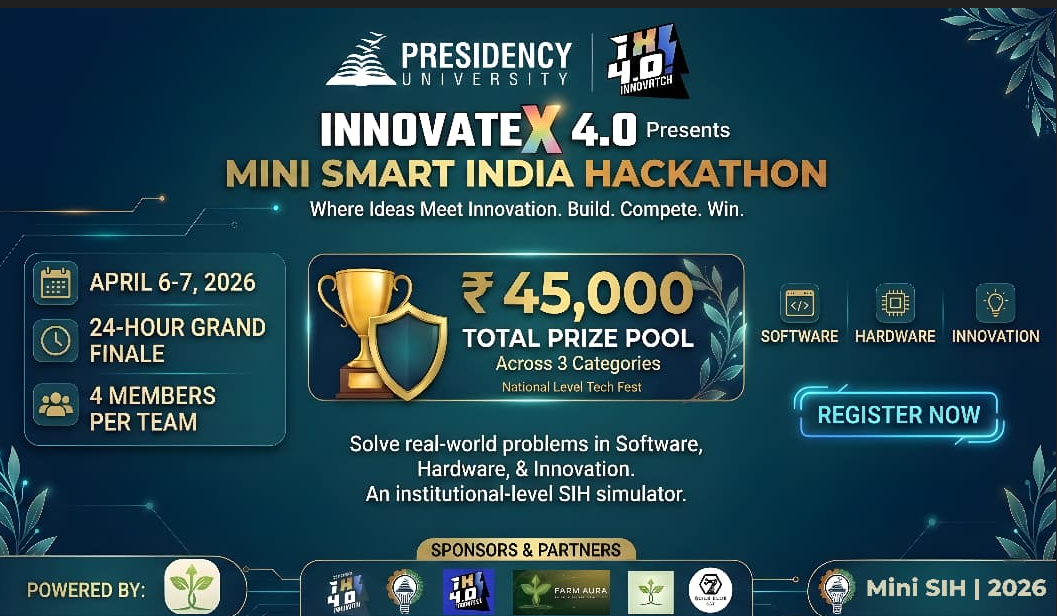
Mini Smart India Hackathon (Mini SIH) is an institutional-level hackathon organized by FarmAura in association with Presidency University, Bengaluru. It is designed to mirror the national Smart India Hackathon in structure, rigor, and competitive spirit. The event will feature a high-intensity 24-hour offline Grand Finale where teams of four participants will work on real-world problem statements sourced from government ministries, industry leaders, NGOs, and AI summits. Participants will compete across three categories: Software Edition, Hardware Edition, and Student Innovation, each evaluated by an expert jury. The hackathon follows the complete SIH-style process, beginning with an online screening round through PPT submissions, followed by shortlisting, mentorship sessions, and finally the offline Grand Finale at the Presidency University campus on April 6–7, 2026. Each team must consist of four members, and it is mandatory to include at least one female participant. Teams with fewer than four members or without a female member will be disqualified.
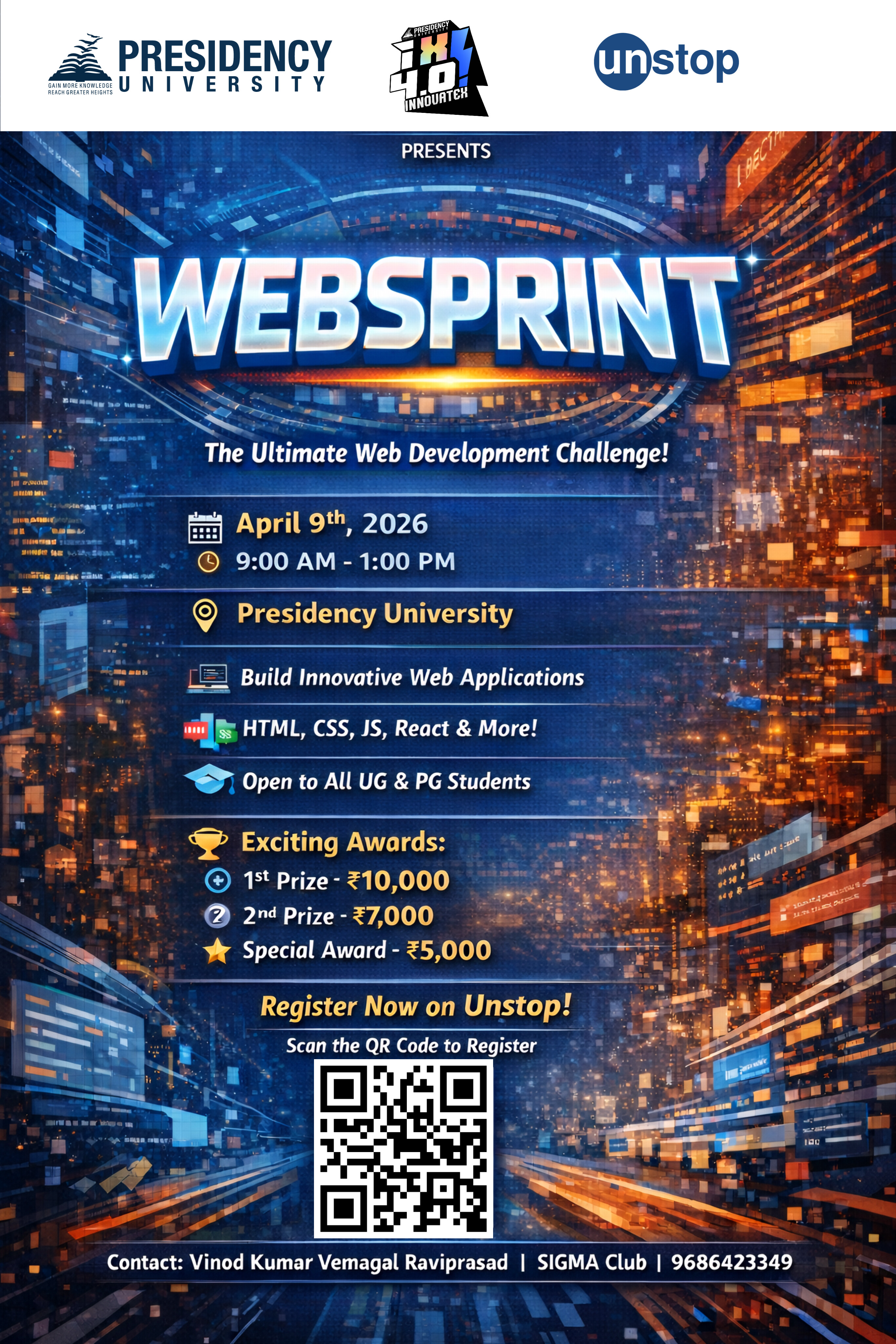
WEBSPRINT is a college-level competitive, responsive web engineering challenge designed to enhance creativity, problem-solving skills, and full-stack development proficiency among students. Participants design and develop innovative, user-centric web applications addressing real-world or campus-centric problems aligned with SDG themes. The event promotes hands-on learning, industry-standard workflows, and real-world application development.
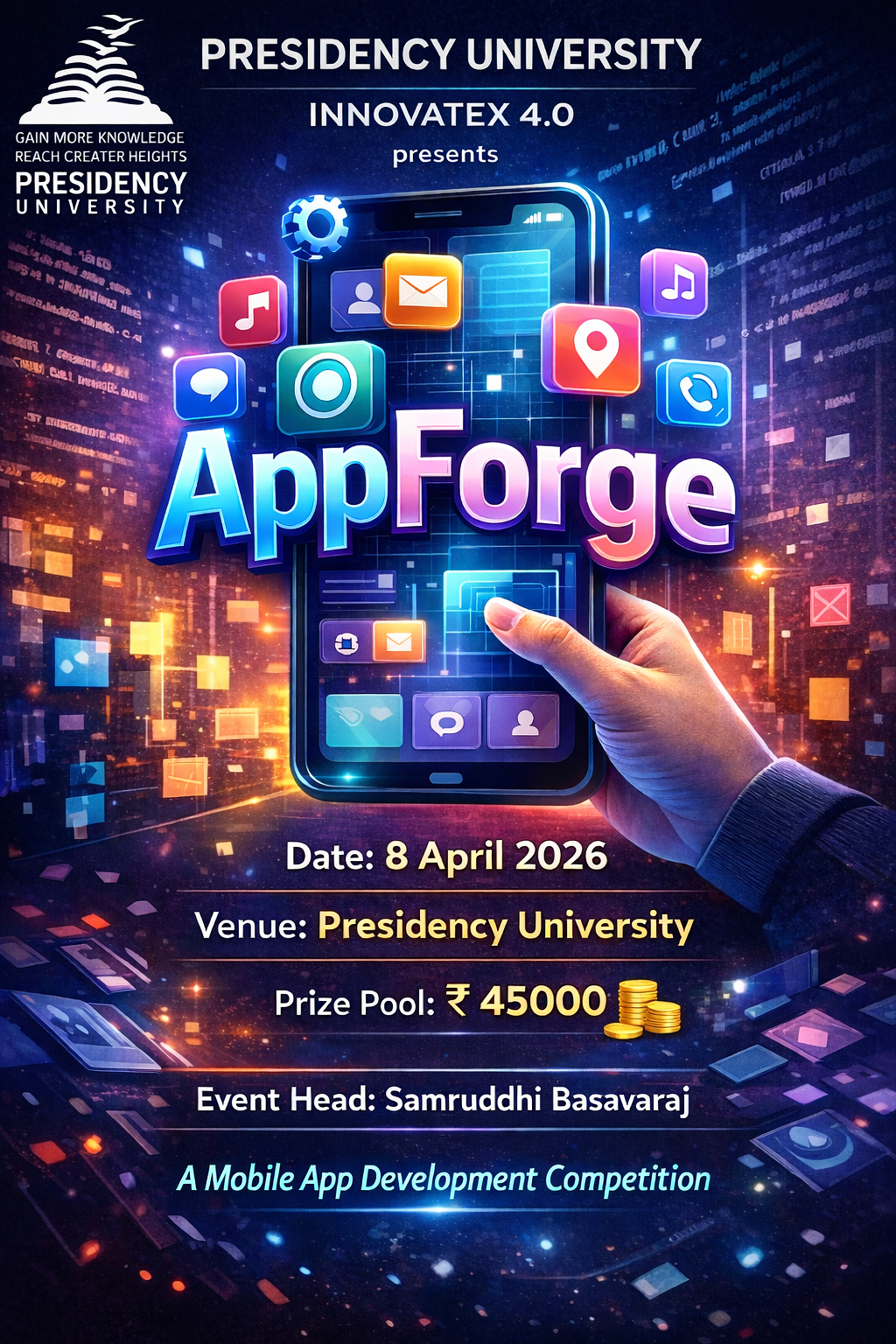
AppForge aims to bridge the gap between theoretical mobile application concepts and real-world product development. By promoting hands-on learning, collaborative problem-solving, and professional development practices, the event prepares students to meet industry-level mobile development standards, making it a high-impact, skill-oriented initiative under Innovatex 4.0. Mobile App Development Challenge is a college-level competitive mobile application development challenge designed to foster innovation, creativity, and end-to-end app engineering skills among students. Organized as a flagship technical event under Innovatex 4.0, AppForge offers a structured platform for participants to ideate, design, develop, and deploy functional, user-focused mobile applications that address real-world or campus-centric problems. Participants compete individually or in teams to transform problem statements into fully functional Android, iOS, or cross-platform mobile applications. The competition emphasizes complete mobile app development workflows, covering modern technologies such as Android Studio, Kotlin, Java, Swift, Flutter, React Native, Firebase, APIs, databases, UI/UX design principles, and mobile security practices. Participants are encouraged to adopt industry-standard development methodologies, including requirement analysis, user journey mapping, wireframing, prototyping, development, testing, and deployment.
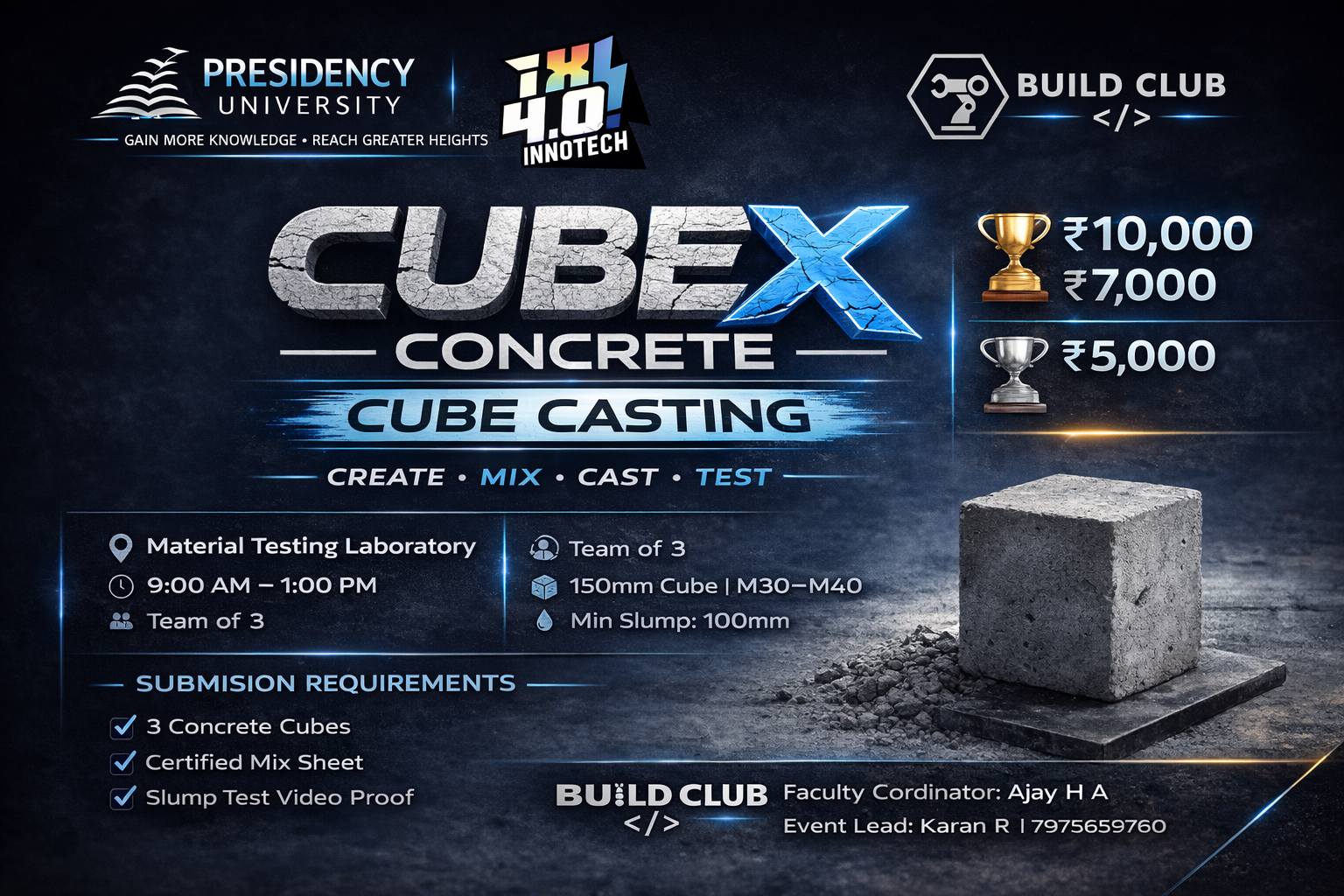
Design, cast, cure, and present three concrete cubes for compressive strength testing. Teams must ensure proper mix design, minimum 100mm slump workability, sharp Es, smooth surface finish, and compliance with IS standards. Testing will be conducted using a Compression Testing Machine (CTM), and the highest valid compressive strengtt within M30-M40 range will determine the winner.
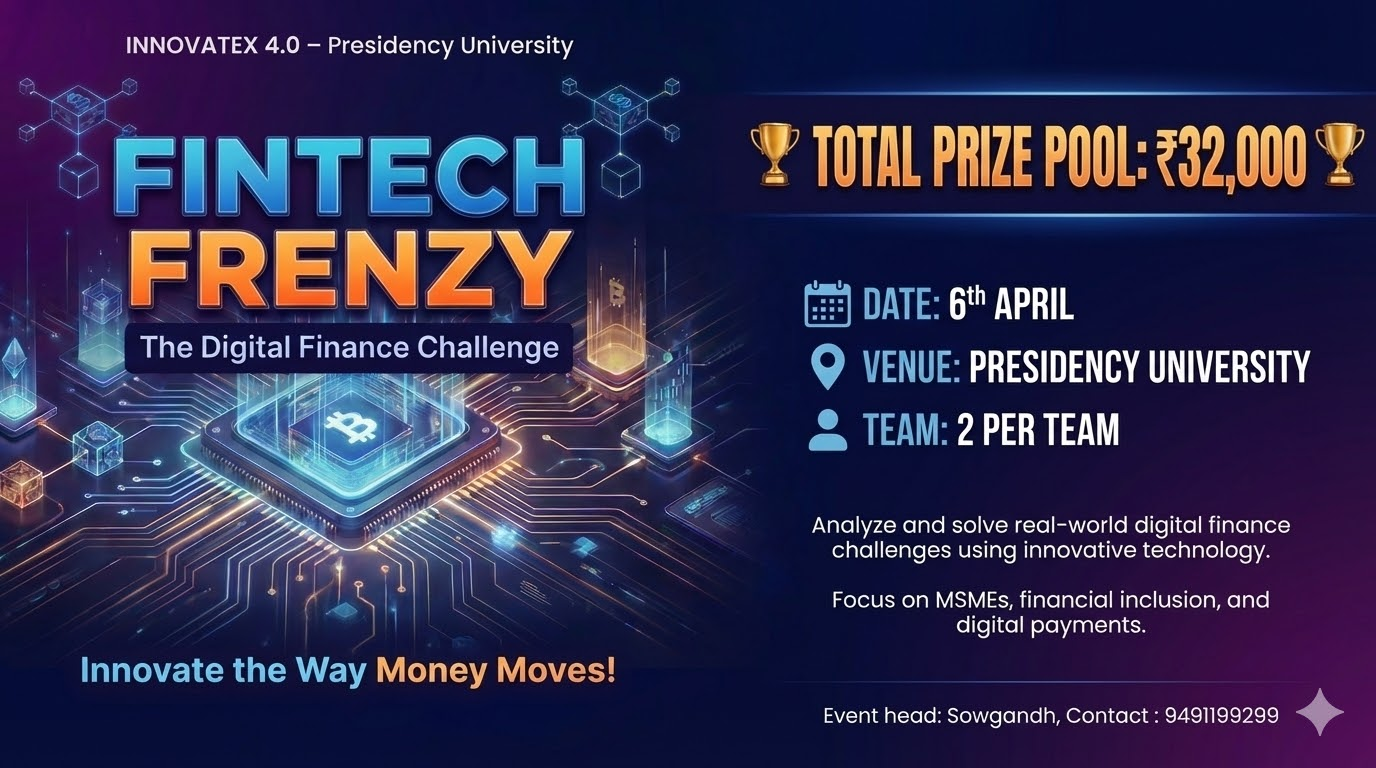
Fintech Frenzy – The Digital Finance Challenge is a software-based FinTech ideathon conducted under INNOVATEX 4.0 at Presidency University, organized by the MakerSpace Cluster. This offline event is designed for teams of two and runs for seven hours (9 AM to 4 PM). The competition aims to provide students with a practical platform to analyze and solve real-world digital finance challenges through innovative, technology-driven solutions. The event primarily focuses on key fintech domains such as digital payments, lending, financial inclusion, and MSME finance. Participants are expected to design solutions that address clearly defined digital finance problems, especially in the context of MSMEs and underserved communities. Solutions may be software-based, hardware-based, or hybrid, but must demonstrate innovation, feasibility, scalability, and user-centric design. Teams must also consider data privacy, security, sustainability, and resource optimization while presenting their solutions. The competition consists of two main rounds. Round 1 includes case analysis, MCQs, and short idea pitching. Round 2 involves presenting the final idea pitch into a real world application based model and final presentation of the ideas. Final evaluation and award distribution conclude the event. Submissions must include a presentation explaining the problem statement, approach, technology used, and impact. Judging is based on innovation, clarity, practicality, financial logic, impact, and presentation skills, totaling 100 points. Winners receive cash prizes of ₹15,000, ₹10,000, and ₹7,000 for first, second, and third places respectively. The event emphasizes originality, ethical conduct, and active participation from all team members.
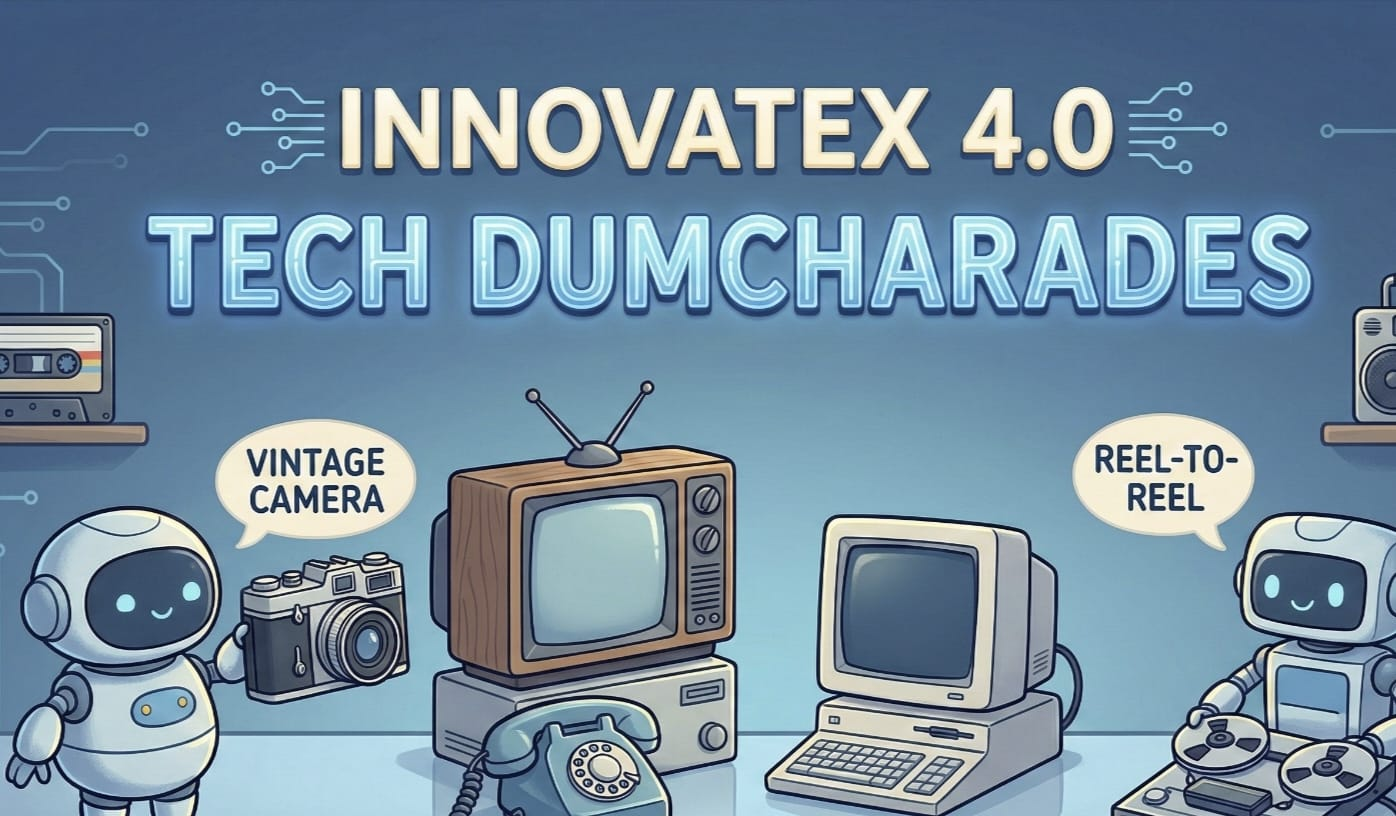
Tech Dumcharades is a fast-paced non-verbal communication challenge where teams must act out technical terms, engineering concepts, and digital processes without speaking. The event tests technical vocabulary, creativity, quick thinking, and team coordination under time pressure. Each round assigns a technical word or phrase to one team member who must convey it through actions alone. Speaking, lip movement, writing in the air, or using props is strictly prohibited. Teammates must correctly guess the term within the given time limit to score points. As rounds progress, the difficulty level increases with more complex technical concepts and multi-word phrases. Special rounds may include process-based mime (such as encryption, debugging, or system crash scenarios) where participants must act out both the problem and the solution. Teams advance based on accuracy and speed of guessing. The event encourages technical awareness blended with performance creativity, making it both educational and highly entertaining. Judges’ decisions are final and binding.
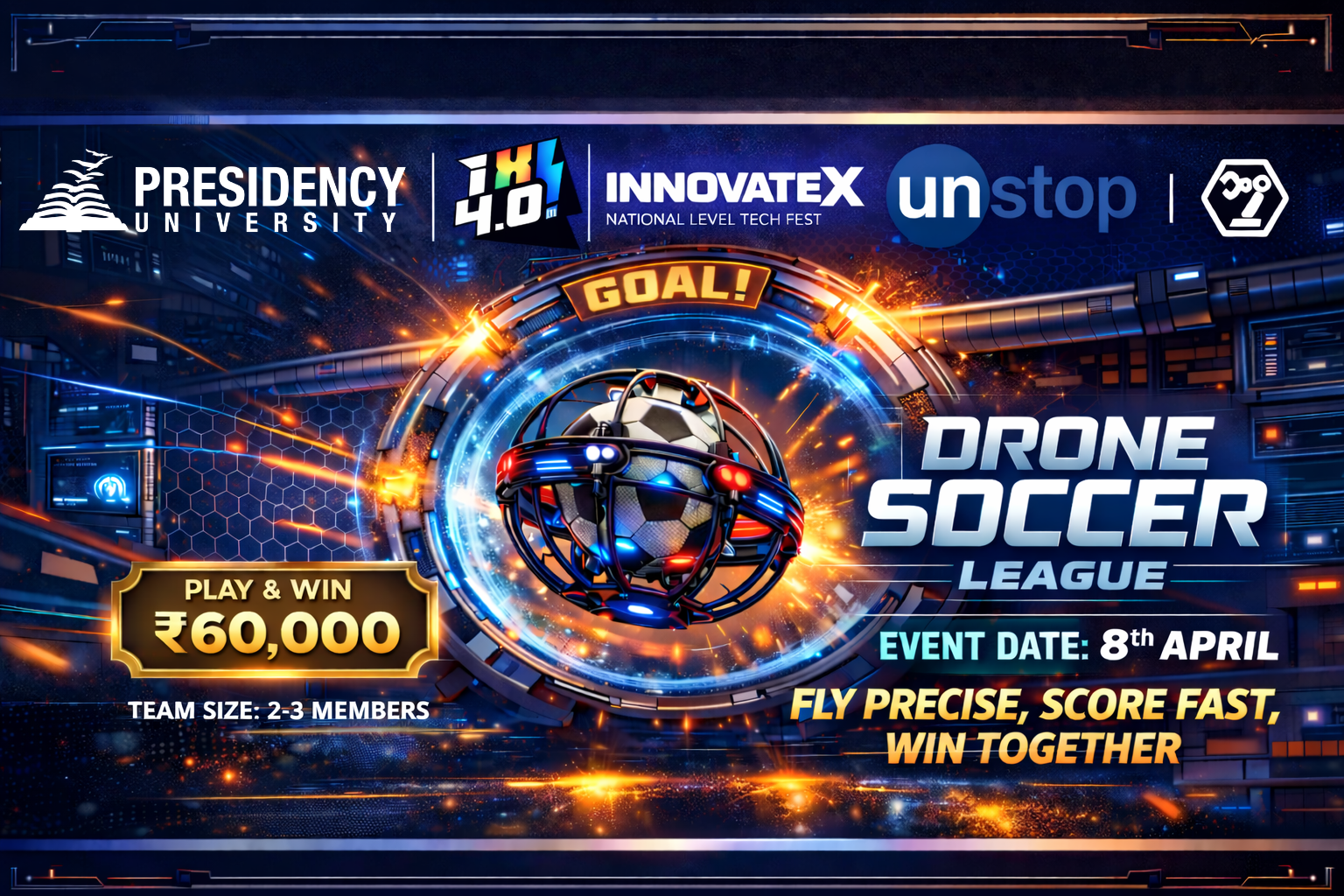
The Drone Soccer League, organized under INNOVATEX 4.0 at Presidency University as part of the MakerSpace Cluster, was a full-day offline aero-bot competition focused on testing students’ drone control skills, teamwork, and safety discipline. Teams of 2–3 members operated fixed-wing soccer drones provided by the organizers, aiming to score goals inside a designated arena, with the first team to cross the goal advancing to the next round. The event included a preflight check round, an elimination goal round, and a stunt round with obstacles, evaluating precision, control, and maneuvering ability. Strict safety guidelines were enforced, and performance was assessed using a 100-point system, including controlling (50 points), arena discipline, safety compliance, and innovation, making the competition a comprehensive test of technical skill, coordination, and responsible drone operation.
Build Bridge – Load Test is a structural engineering challenge where teams must design and construct a bridge that spans a fixed gap and withstands increasing loads without collapsing. Using only the materials provided at the venue, participants must apply principles of balance, load distribution, and structural stability within a limited time frame. The competition begins with a briefing phase where specifications such as span length and restrictions are explained. Teams must then construct their bridge during the allocated build time. No external supports, adhesives beyond those provided, or pre-built components are allowed. The bridge must rest freely between two platforms and remain stable during testing. In the load testing phase, judges will gradually apply weight to each bridge. Additional tests such as off-center loading or vibration checks may be introduced. The bridge that supports the maximum load while maintaining structural integrity will be declared the winner. The event promotes teamwork, innovation, time management, and real-time problem-solving under pressure. Judges’ decisions are final and binding.
Tower Titans is a fun engineering-based physical and creative challenge designed to test participants’ structural design skills, teamwork, and time management. In this event, teams of two must build the tallest free-standing structure using only the materials provided within the given time limit. The competition consists of three rounds. In Round 1, teams focus on building a strong and stable foundation within 20 minutes. The structure must stand independently without any external support. Teams that fail to achieve stability will be eliminated. In Round 2, additional materials are provided, and teams must extend their structure vertically within 25 minutes. The structure must remain free-standing and stable for at least 20 seconds. One retry is allowed with a penalty. Round 3 is the final stability test, where judges measure the height and test structural strength through controlled vibration or airflow. The tallest and most stable structure will be declared the winner. The event promotes creativity, structural understanding, problem-solving under pressure, and effective team coordination. Only provided materials are allowed, and judges’ decisions are final.
Circuit Burn is a high-energy live tech roast battle designed to test participants’ wit, creativity, stage presence, and spontaneous thinking. In this event, teams of four will be assigned a technology-related topic and must deliver a humorous yet respectful roast performance based on it. The competition consists of three stages. In Stage 1, teams receive their topic at random and are given limited preparation time to brainstorm jokes, references, and creative angles. No pre-written scripts or external assistance is allowed. In Stage 2, each team performs a 3–4 minute live roast on stage. The roast must focus on the assigned technology, gadget, or concept without making personal attacks. Humor should remain clever, relevant, and engaging. In Stage 3, judges may introduce a rapid-fire “Burn Back” round where teams must respond instantly to counter comments or surprise prompts. The event promotes quick thinking, technical awareness, teamwork, and confident public speaking. Creativity, delivery, and audience engagement play a major role in scoring. Judges’ decisions are final.
Grandma Heads Up is a fast-paced communication game inspired by Heads Up and Charades, designed to test clarity, creativity, and quick thinking. In this event, one team member holds a technical term displayed on a card facing their teammates without seeing it. The remaining teammates must help them guess the word using only simple, everyday language — as if explaining it to a grandmother with no technical background. No technical jargon, abbreviations, or complex terms are allowed. If a participant accidentally uses restricted words, the round is paused and points may be deducted. Each correct guess within the time limit earns points. The game progresses through increasing difficulty levels — starting with basic tech terms and advancing to more complex digital concepts. Special lightning rounds may include mime-only hints or single-word clues for bonus scoring. The team with the highest score after all rounds wins. The event promotes communication skills, conceptual understanding, teamwork, and quick decision-making in an engaging and energetic format. Judges’ decisions are final and binding.
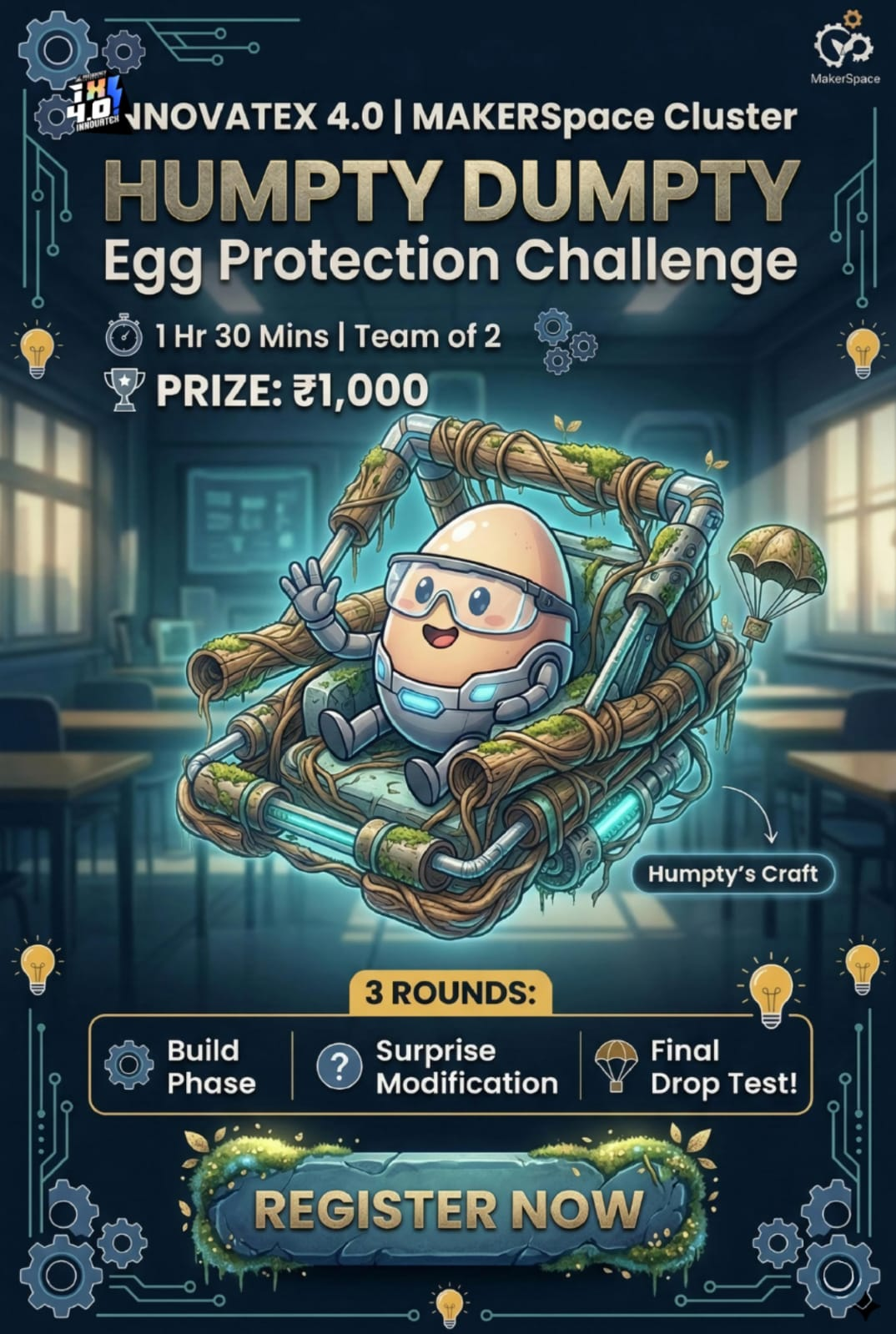
HUMPTY DUMPTY – Protect to Survive is a fun engineering challenge conducted under the MakerSpace Cluster. Participants must design and construct a protective structure for an egg (“Humpty”) using the provided materials. The goal is to ensure that the egg survives impact under test conditions. The event consists of multiple phases including Registration & Briefing, Build Phase, Modification Round, and Final Drop Test. During the build phase, teams create their protection device using limited materials such as cardboard, straws, foam, and rubber bands. In the next phase, teams must adapt their designs based on a surprise modification challenge. This may involve removing a component, adding weight, or making structural adjustments within a short time limit. Finally, all devices undergo a drop test from a predetermined height. The egg must remain intact to qualify. In case of tie situations, judging will be based on minimum mass, compactness, and creativity of design. Speed, adaptability, and effectiveness of protection determine the winners. The team whose egg survives the drop test with the most efficient and creative design will be declared the winner.
Love at First Byte is a creative improv and marketing challenge designed to test participants’ storytelling skills, innovation, and persuasive communication. In this event, teams of four will be assigned a mystery gadget at random and must convince the judges why it is the most revolutionary invention ever created. The competition consists of three phases. In Phase 1, teams receive their assigned gadget and are given preparation time to brainstorm ideas, features, and a compelling narrative. No pre-prepared scripts or digital assistance is allowed. In Phase 2, teams deliver a live 3-minute pitch presentation. The pitch must include the gadget’s unique selling points, target audience, creative angle, and future potential. Teams are encouraged to use humor, emotional appeal, and confident stage presence. In Phase 3, judges may introduce surprise constraints such as marketing the gadget in the future, selling it to a specific audience, or rebranding it creatively. The event promotes creativity, quick thinking, marketing skills, teamwork, and stage confidence. Only ideas developed during preparation time are allowed, and judges’ decisions are final.
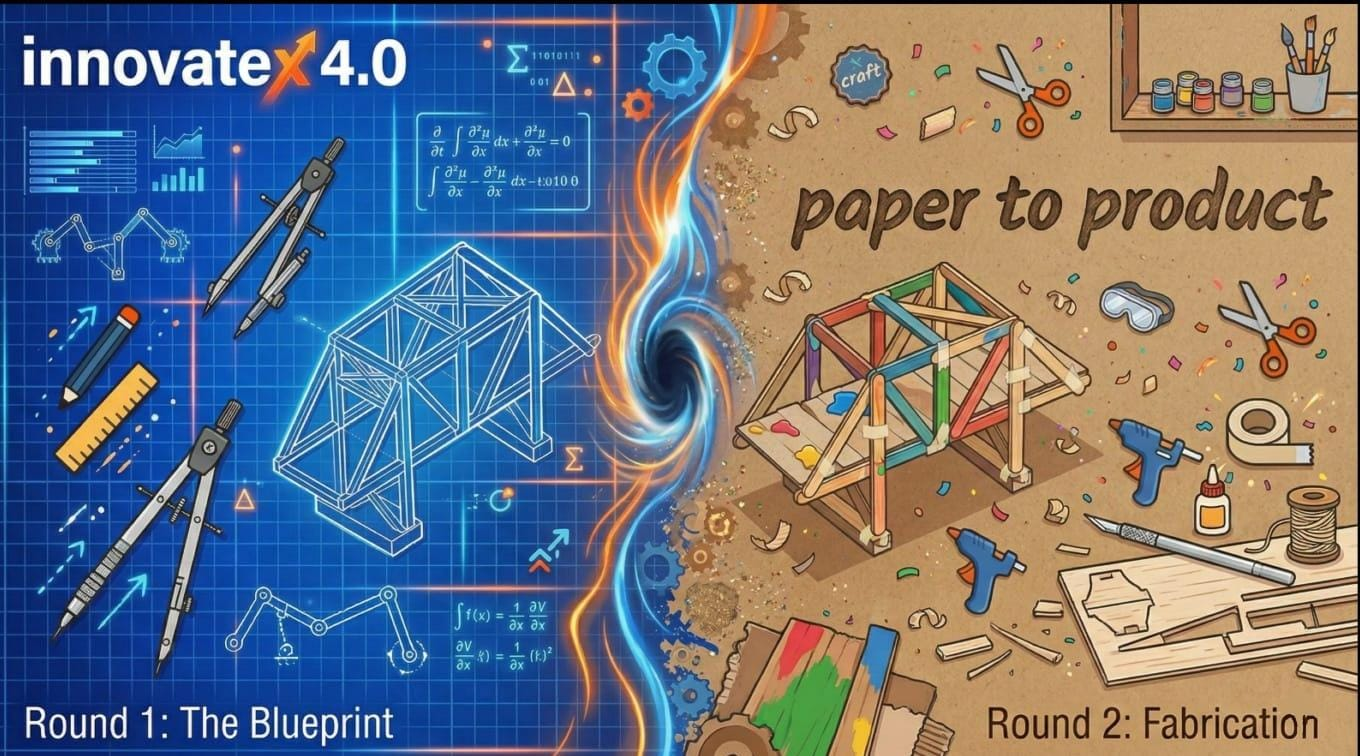
Paper to Product is a prototyping and engineering challenge conducted under the MakerSpace Cluster at INNOVATEX 4.0. The event bridges the gap between theoretical design and practical implementation. Participants first conceptualize a solution on paper and then build a functional prototype using limited materials provided by the organizers. The event consists of three rounds: Round 1 – The Blueprint: Teams design and draw a detailed labeled diagram with a material list (15 minutes). Round 2 – The Fabrication: Teams construct the prototype strictly according to their blueprint using the provided materials (45 minutes). Round 3 – The Stress Test: The final product is tested for structural integrity and functionality. Judging is based on structural strength, accuracy to blueprint, innovation, and discipline. Only organizer-provided materials are allowed. Judges’ decisions are final.
BizTech Pitchathon – FinTech Startup Ideas is a startup pitching competition that challenges students to design innovative financial technology solutions for real-world problems. The event focuses on encouraging participants to combine business strategy with technology to create impactful startup ideas in the FinTech sector. Participants will work in teams to identify a financial challenge and develop a technology- driven solution that can address it effectively. The idea should demonstrate innovation, practicality, and a clear business model. Teams will also need to explain how their solution creates value for users and how it can grow into a scalable startup. The competition consists of two rounds. In the first round, teams present a short pitch describing their problem statement, proposed solution, and target users. Based on the quality and feasibility of the idea, teams will be awarded with points. In the final round, teams present a detailed startup pitch before a panel of judges, explaining their business model, technology integration, market potential, and financial viability. The event aims to provide students with an opportunity to explore entrepreneurial thinking, understand the FinTech ecosystem, and develop skills in innovation, problem-solving, and professional pitching.
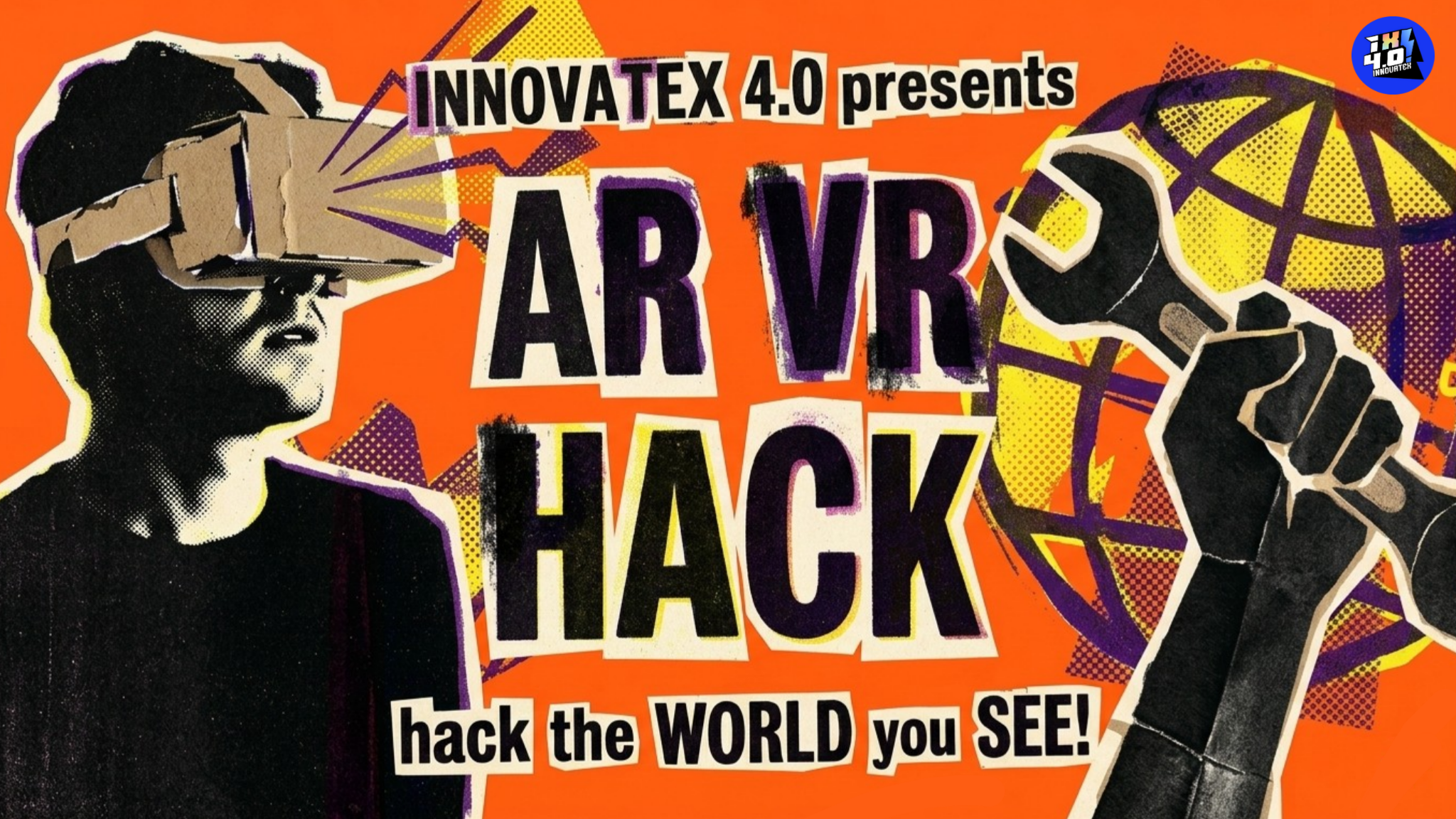
AR VR HACK is an offline inter-college showcase competition conducted under INNOVATEX 4.0 at Presidency University, Bengaluru. The event provides a platform for students to present pre-developed Augmented Reality (AR) and Virtual Reality (VR) solutions that address real-world challenges across diverse domains such as education, simulations, gaming, training, and innovative immersive applications. Participants demonstrate their projects through live walkthroughs and structured presentations, highlighting problem understanding, technical implementation, and real-world relevance. All solutions must be developed using Unity and should effectively utilize AR/VR technologies to create meaningful and impactful user experiences. The event encourages innovation, creativity, and practical problem-solving through extended reality technologies.
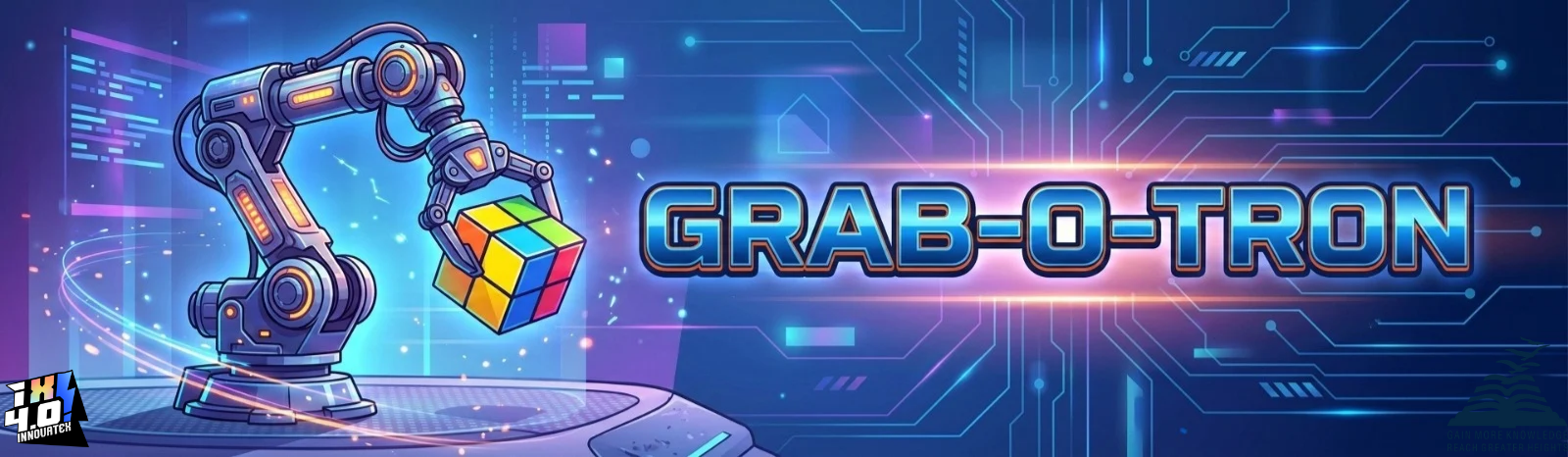
Grab-O-Tron is a robotics challenge designed to test innovation, precision, and control. Participants must design, build, and program a robot capable of grasping and transporting objects within a defined arena. The event consists of 2 progressively challenging rounds, where robots must pick and place objects of varying shapes, positions, and weights (50-100 g) at distances ranging from 2–3 meters. Teams will be evaluated based on accuracy, mechanical design, programming efficiency, object handling, and completion time.

The event is a flagship initiative to foster creativity and multidisciplinary engineering excellence. Participants must identify real-world problems and develop working prototypes across domains like AI, IoT, Robotics, and Sustainable Engineering. The goal is to bridge the gap between theoretical learning and practical application.
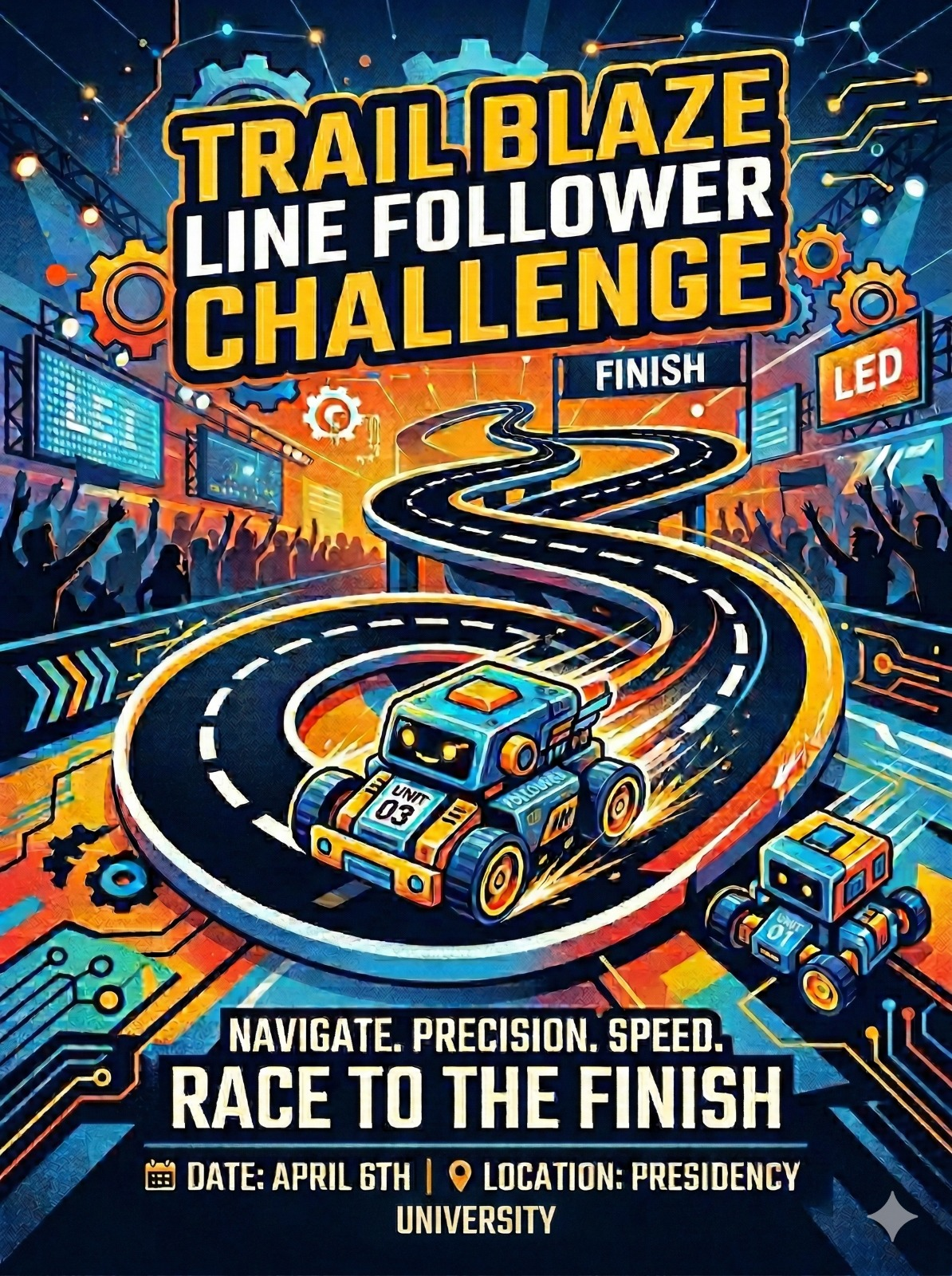
Get ready for a classic robotics competition that tests the precision, speed, and intelligence of autonomous robots. Participants must design and program a wireless robot capable of following a black line on a white background, navigating an unseen path with sharp bends, curves, mazes, and intersections. The competition consists of three rounds: Qualifiers, Semi-Finals, and Finals, challenging teams to debug and optimize their bots for peak performance under pressure.
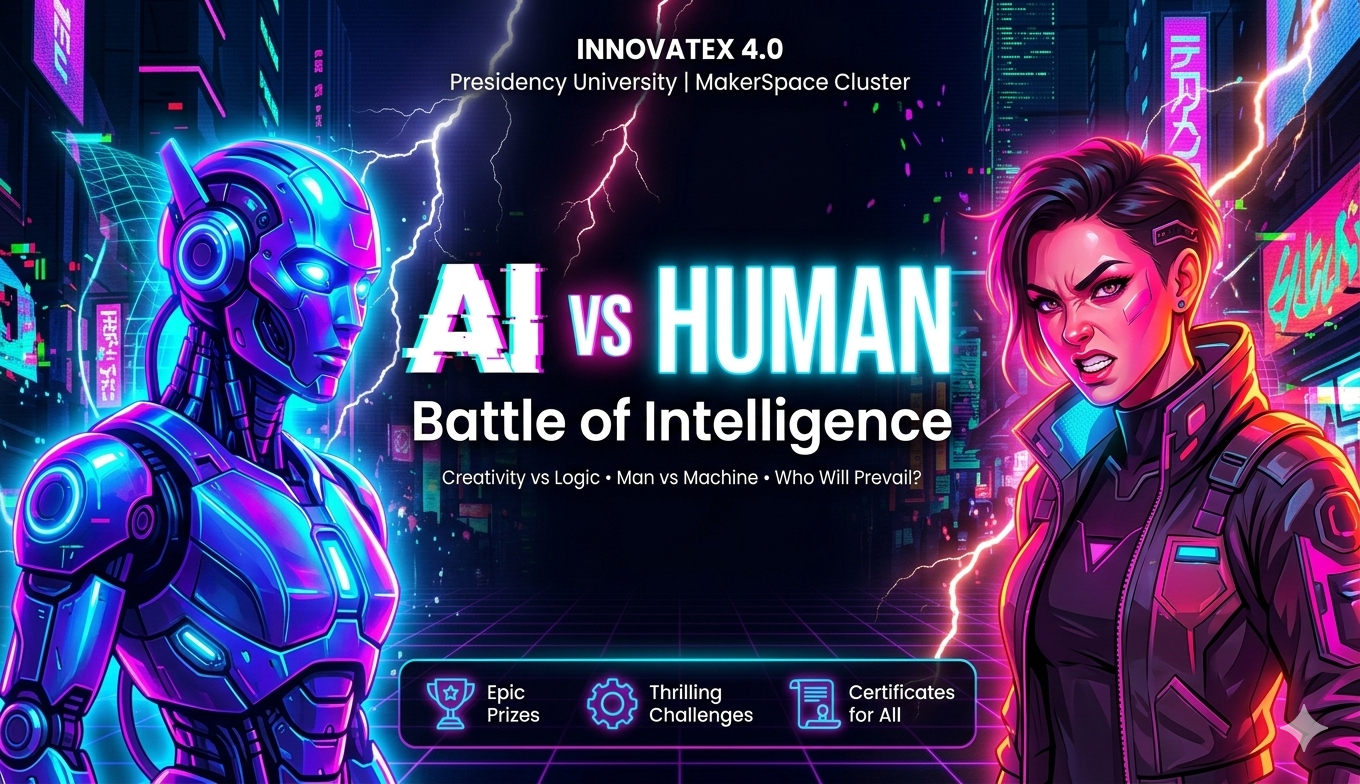
AI vs Human: Battle of Intelligence is a technical and creative competition conducted under INNOVATEX 4.0 by the MakerSpace Cluster at Presidency University. The event compares human intelligence, creativity, and logical reasoning with responses generated by modern Artificial Intelligence tools such as ChatGPT and Google Gemini. Participants will compete against AI-generated outputs in multiple rounds designed to test knowledge, creativity, and analytical thinking. The goal of the event is to demonstrate how human originality, contextual understanding, and problem‑solving abilities can outperform AI-generated responses in real time. The competition will be conducted offline and will include rounds such as a Quiz Battle, Creativity Challenge, and Logical Reasoning round. AI responses will be generated only by the organizers for comparison purposes. Participants are strictly not allowed to use any AI tools during the event. The event aims to create awareness about the ethical use of Artificial Intelligence while encouraging innovation, critical thinking, and collaborative problem‑solving among students.
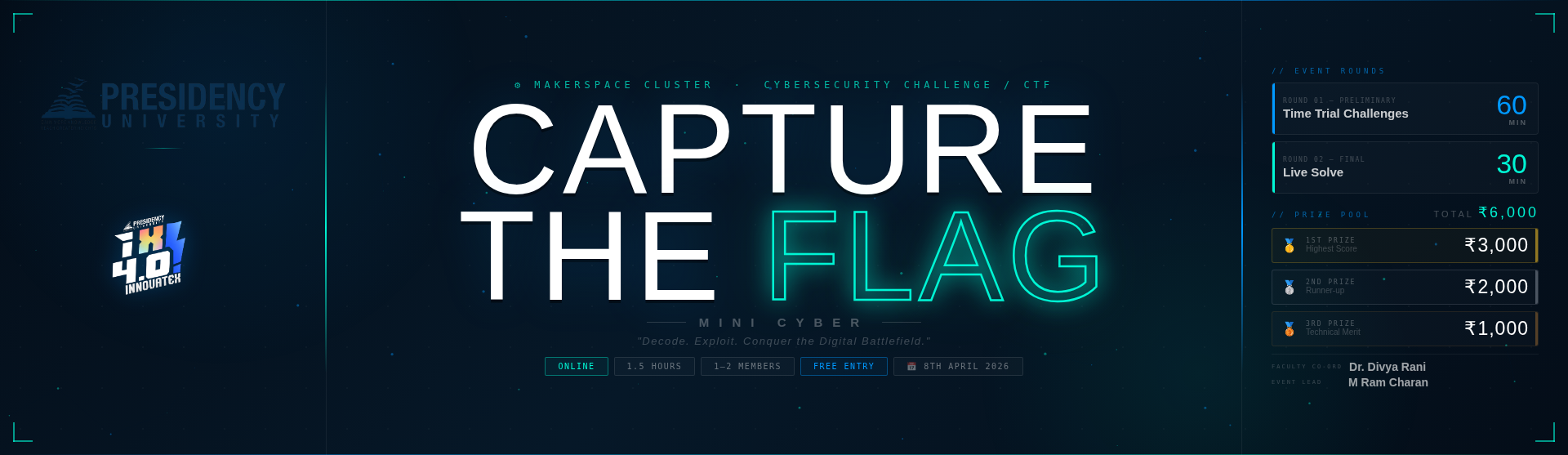
Capture the Flag — Mini Cyber is organized by the MakerSpace Cluster at Presidency University as part of INNOVATEX 4.0. Designed to bridge theoretical knowledge and real-world application, participants think like ethical hackers and apply practical cybersecurity skills under timed, competitive conditions. The event runs entirely online, making it accessible to a wider range of participants while maintaining the rigor of a live competition. Teams tackle challenges across four core domains: Cryptography, Digital Forensics, Web Exploitation, Reverse Engineering.
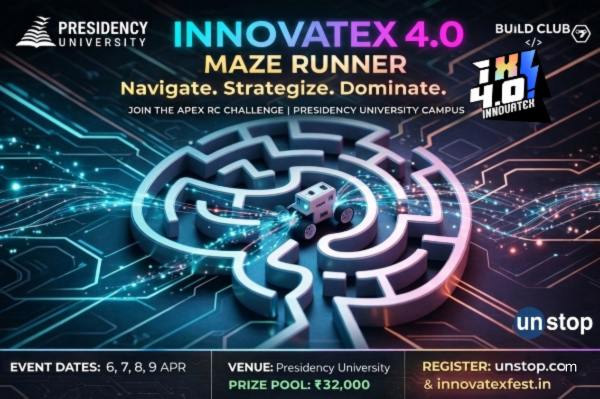
Maze Runner is a robotics challenge where teams guide a remote-controlled bot through a maze filled with turns, bridges, and scoring zones. Participants must combine precision driving, smart strategy, and quick decision-making to finish the course while minimizing penalties and maximizing performance.
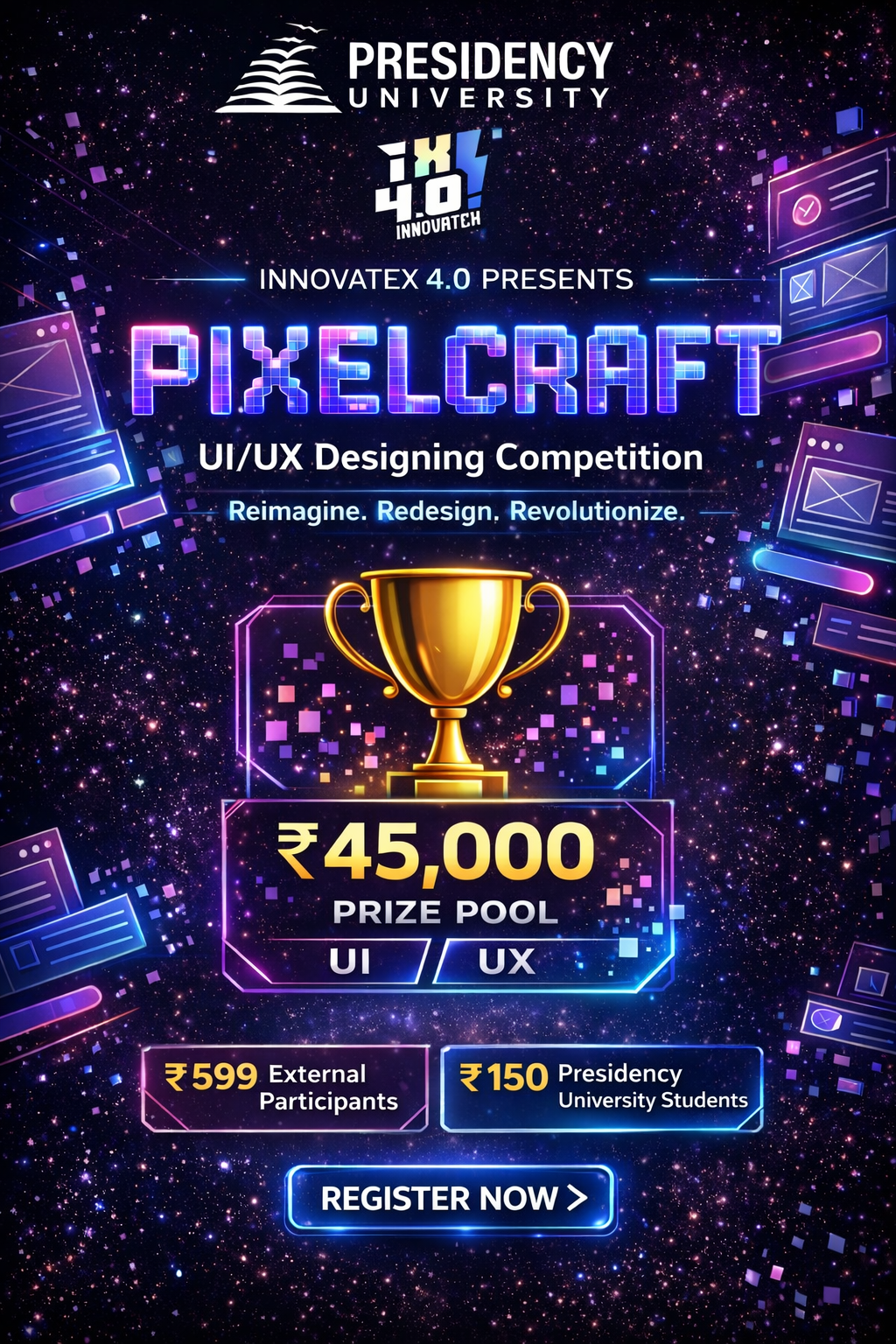
The main objective of PIXEL CRAFT is to promote innovation and Interdisciplinary learning. Modern day applications and websites require interactive and simple interfaces in order to cater to the needs of every age group. The attention span of the current generation is declining so we need an interface that is simple and allows us to do the desired task like e-commerce, social networking, education and learning in the easiest way without facing any hindrance. Companies often work extensively on the back-end technology but lag behind on User Interface and User Experience (UI/UX). Pixel Craft encourages the participants to design interfaces that cater to the User Experience (UX). Additionally, Pixel Craft also promotes innovation and interdisciplinary learning. Pixel Craft – UI/UX Design Challenge is an exciting and fast-paced design competition that puts participants’ creativity, problem-solving abilities, and user-centric thinking to the ultimate test. Teams will conceptualize and build a complete high-fidelity UI/UX solution in Figma within 6 hours, followed by a 10–20 minute presentation. No templates or external assistance are allowed.
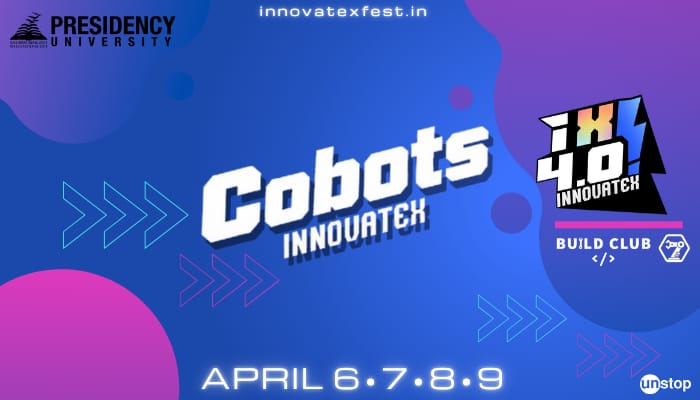
COBOTS is a single-mission collaborative robotics competition where teams build two distinct robots that must work together to complete a search-and-rescue style mission inside a 6m x 6m obstacle arena. The mission relies on an autonomous "Scout Bot" that navigates the arena, locates a hidden yellow payload, and wirelessly transmits a live map and coordinates. The "Arm Bot" operator then uses only this transmitted map on a laptop screen to semi-manually navigate to the payload, pick it up with a gripper arm, and return it to the home base. Both bots operate simultaneously during a strict 12-minute run. All robots must be self-fabricated (no pre-built kits) within a combined budget cap of ₹15,000, testing skills in embedded systems, wireless communication, and mechanical design.
Go Connect is a mini-competition under INNOVATEX 4.0 – MakerSpace Cluster, Presidency University, designed to challenge participants in the field of Artificial Intelligence and adversarial search techniques. In this event, teams must design and implement an AI agent in Python capable of playing “Connect Go,” a 5-in-a-row zero-sum strategy game on an 8×9 board. The objective is to apply minimax (with optional alpha-beta pruning) to create an intelligent agent that makes optimal decisions against an opponent. Participants will build the complete game logic from scratch, including valid move implementation, win detection, and heuristic evaluation. The competition tests algorithmic thinking, strategic planning, optimization skills, and real-time decision-making. The event consists of two rounds: development and testing of the AI model, followed by live AI vs AI matches where teams will also present their strategy and heuristic approach. Final evaluation will consider gameplay performance, technical quality, innovation, and presentation. Go Connect provides a platform for students to showcase their programming expertise, problem-solving abilities, and understanding of AI fundamentals in a competitive yet intellectually stimulating environment.
SteelWaves is a high-intensity RC boat rally that puts precision and control at the forefront. Participants are challenged to design and pilot their boats through a demanding water circuit where sharp turns and confined paths leave no room for error. In this performance-driven format, each team gets one timed opportunity to take on the course across two continuous laps. With boats entering the arena individually, every run becomes a test of nerve, consistency, and mastery over motion. The first lap sets the pace, pushing teams to navigate the circuit with confidence. The second lap raises the stakes — demanding sustained stability and composure under pressure. With no retries, success depends entirely on how efficiently teams balance speed with control. Final rankings will be determined by timing, rewarding those who can command their machine through the course with precision and discipline. SteelWaves isn’t just about going fast — it’s about staying in control when it matters most.
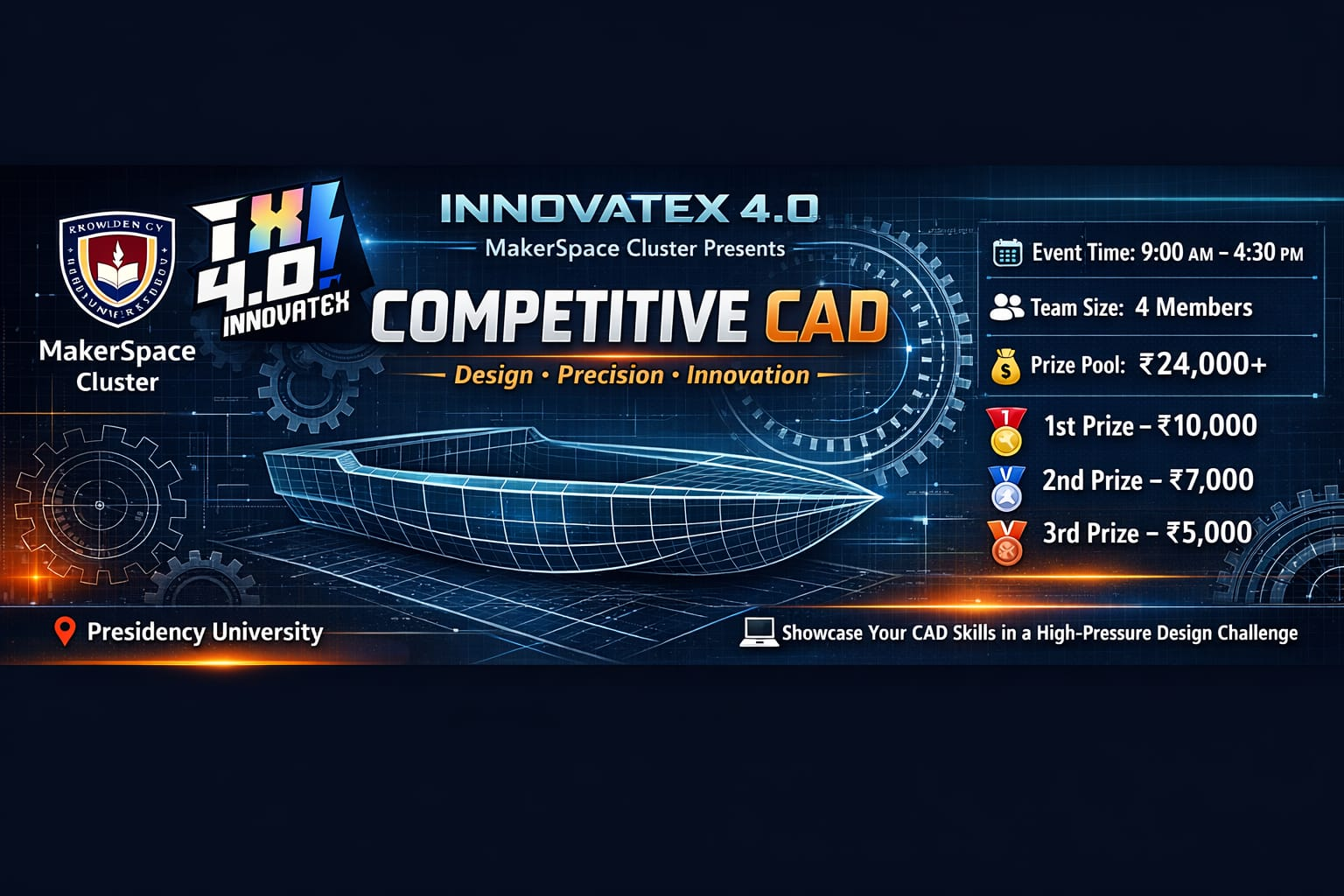
The objective of Competitive CAD is to provide a high-pressure, standardized environment where students can validate their technical skills and benchmark their proficiency against peers. The event aims to identify top talent in technical modeling and precision while fostering practical innovation by challenging participants to design functional solutions for real-world engineering problems. Beyond skill validation, the event is designed to enhance employability by allowing participants to add a verifiable, high-level achievement to their professional portfolios, demonstrating their ability to deliver complex design work under strict deadlines. Specifically, the competition tasks participants with achieving high accuracy in their models and successfully generating a complete documentation package, including native CAD files, universal exports, and fully dimensioned 2D technical drawings.
AI in Action – A Rapid Build Event is a hands-on competition designed to immerse students in the complete lifecycle of building AI-powered solutions. The event challenges participants to transform real-world datasets into meaningful, deployable products within a structured and time-bound environment. Instead of focusing only on coding accuracy, participants engage in problem identification, data exploration, model development, and solution design. Teams define unique problem statements, analyze datasets, select suitable algorithms, and develop AI models to address real challenges. They are also encouraged to consider usability, scalability, and ethical implications to ensure responsible innovation. The rapid-build format promotes efficient thinking, strategic decision-making, and effective collaboration under time constraints. By guiding students from concept to deployment, the event fosters product-oriented thinking and mirrors real industry workflows. AI in Action bridges the gap between academic learning and practical application, helping participants gain confidence in developing real-world AI solutions—true to its philosophy: From Data to Deployment.
DRONETRIX DAY is a daylight drone and FPV competition under INNOVATEX 4.0 where teams design and operate student-built drones in controlled conditions, testing engineering skills, piloting precision, teamwork, and strict safety compliance.
DRONETRIX NIGHT is a night-time FPV drone challenge under INNOVATEX 4.0 where teams operate LED-equipped drones in low-light conditions, focusing on visibility control, advanced piloting, situational awareness, and strict night-flight safety protocols.
Patch OR Perish is a secure coding challenge conducted under INNOVATEX 4.0 at Presidency University. The event is an 8-hour offline competition where teams of four participants analyze and secure a pre-configured vulnerable web application. The application is intentionally designed with security flaws aligned with the OWASP Top 10, including SQL Injection, Cross-Site Scripting (XSS), insecure authentication, broken access control, and improper input validation. The primary objective is to identify critical vulnerabilities, implement secure coding fixes, and ensure the application maintains its original functionality without introducing new flaws. Teams are required to submit the updated source code along with documentation explaining the identified vulnerabilities, their potential impact, and the remediation steps taken to secure the application.
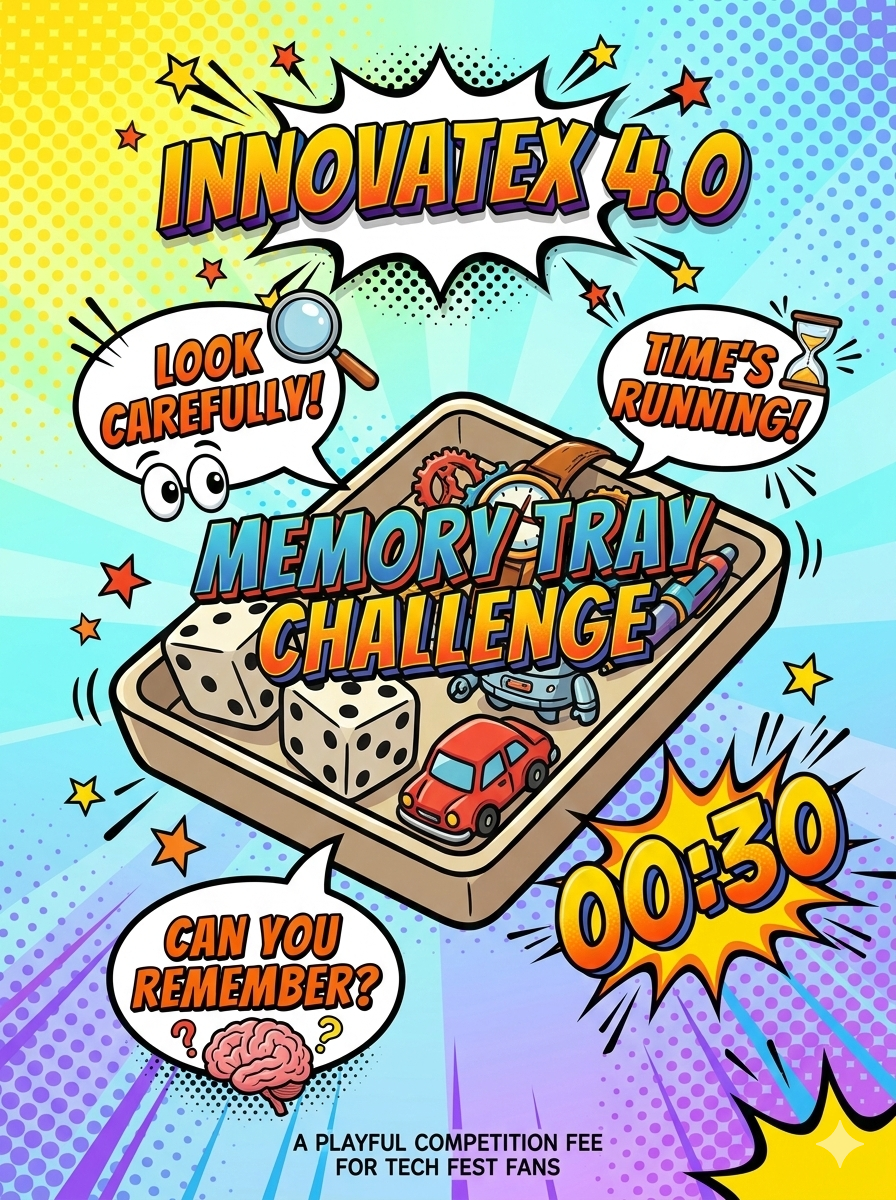
Memory Tray Challenge is a technical memory-based competition designed to test participants’ visual retention, technical awareness, and mental agility. Participants observe a tray containing 25+ technical components such as ICs, sensors, tools, and microcontrollers for a limited time. The event consists of three rounds. In Round 1, participants observe the tray for 60 seconds and then list all items within 2 minutes. In Round 2, a new set of components is shown, and participants must recall specific technical attributes like pin count or color codes. Points are deducted for incorrect answers. Round 3 is a sudden death round where technical images are flashed for 3 seconds, and participants must instantly identify components or detect missing parts in circuits. The competition emphasizes photographic memory, component recognition, accuracy, speed, and discipline. Electronic devices are strictly prohibited, and judges’ decisions are final.
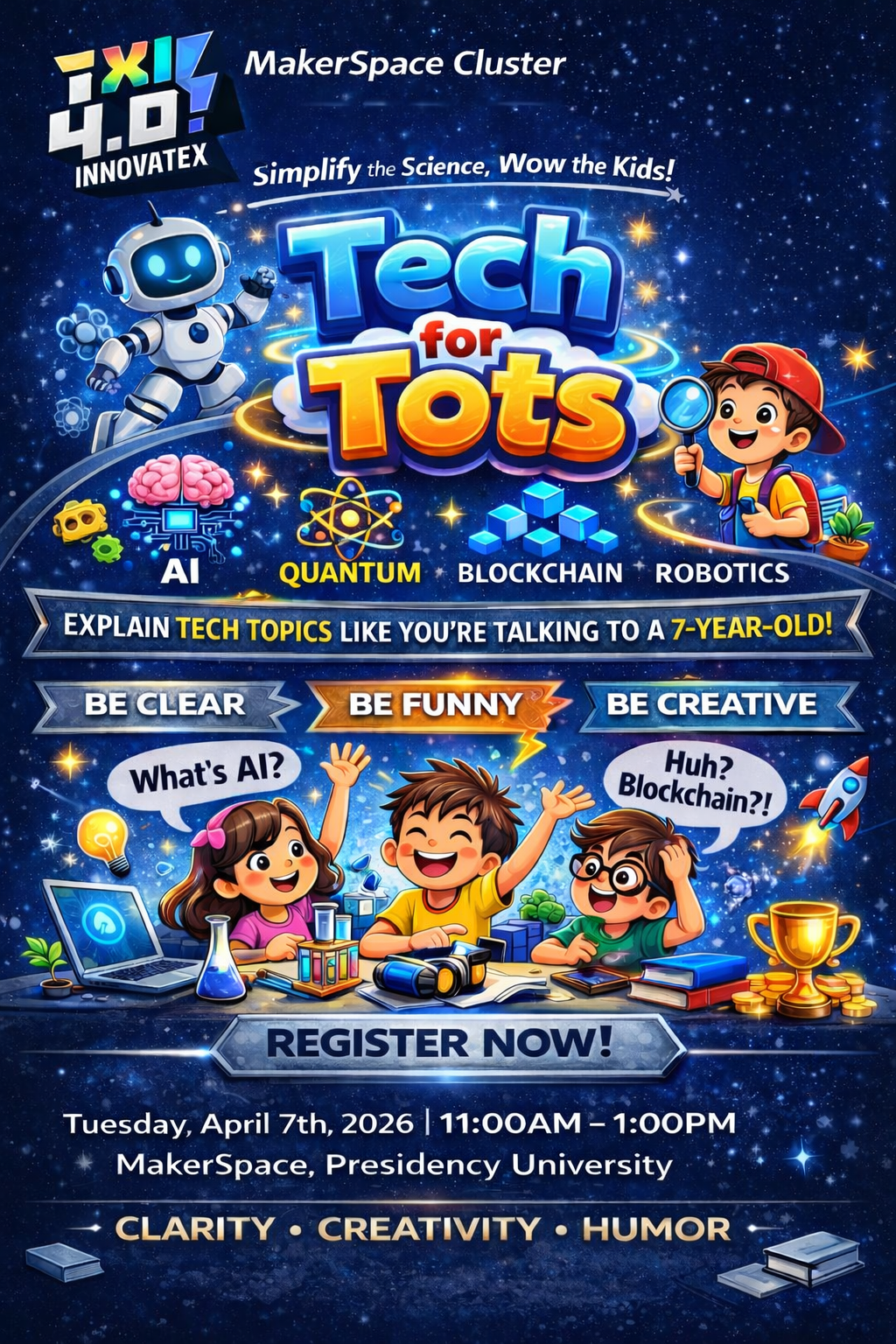
Tech for Tots – Explain It to a Kid is an engaging communication challenge conducted under INNOVATEX 4.0 by the MakerSpace Cluster, Presidency University. The event challenges participants to simplify complex technological concepts and explain them as if teaching a child aged 6–10 years. Participants will choose one topic from Artificial Intelligence, Quantum Computing, Blockchain, or Robotics and present it in the most simple, creative, and engaging way possible. The goal is not deep technical complexity, but the ability to communicate ideas clearly using stories, analogies, humor, and real-life examples. Each participant or team will have 3–5 minutes to present their explanation. Judges may ask follow-up questions to evaluate the participant’s understanding of the concept. The event focuses on clarity of thought, creativity, communication skills, and conceptual accuracy. Tech for Tots encourages participants to break down complicated ideas and make technology accessible to everyone. It celebrates the ability to turn advanced concepts into simple explanations — a skill essential for innovators, educators, and future leaders in technology.
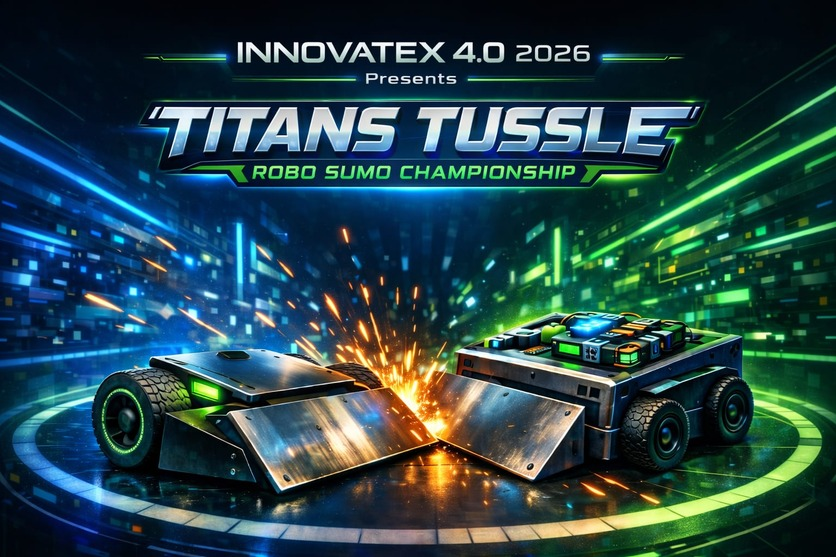
Robo Sumo is an exciting robotics battle where teams compete using their own built robots in a sumo-style arena. The goal is to push your opponent’s robot out of the ring and stay inside to win. The event features multiple rounds, including themed challenges such as obstacle rounds, endurance battles, and surprise rounds. Each round will test different aspects of your robot’s strength, control, and strategy. Compete against other teams, adapt to different challenges, and prove your robot is the strongest. The top teams will advance through rounds and battle for the championship.
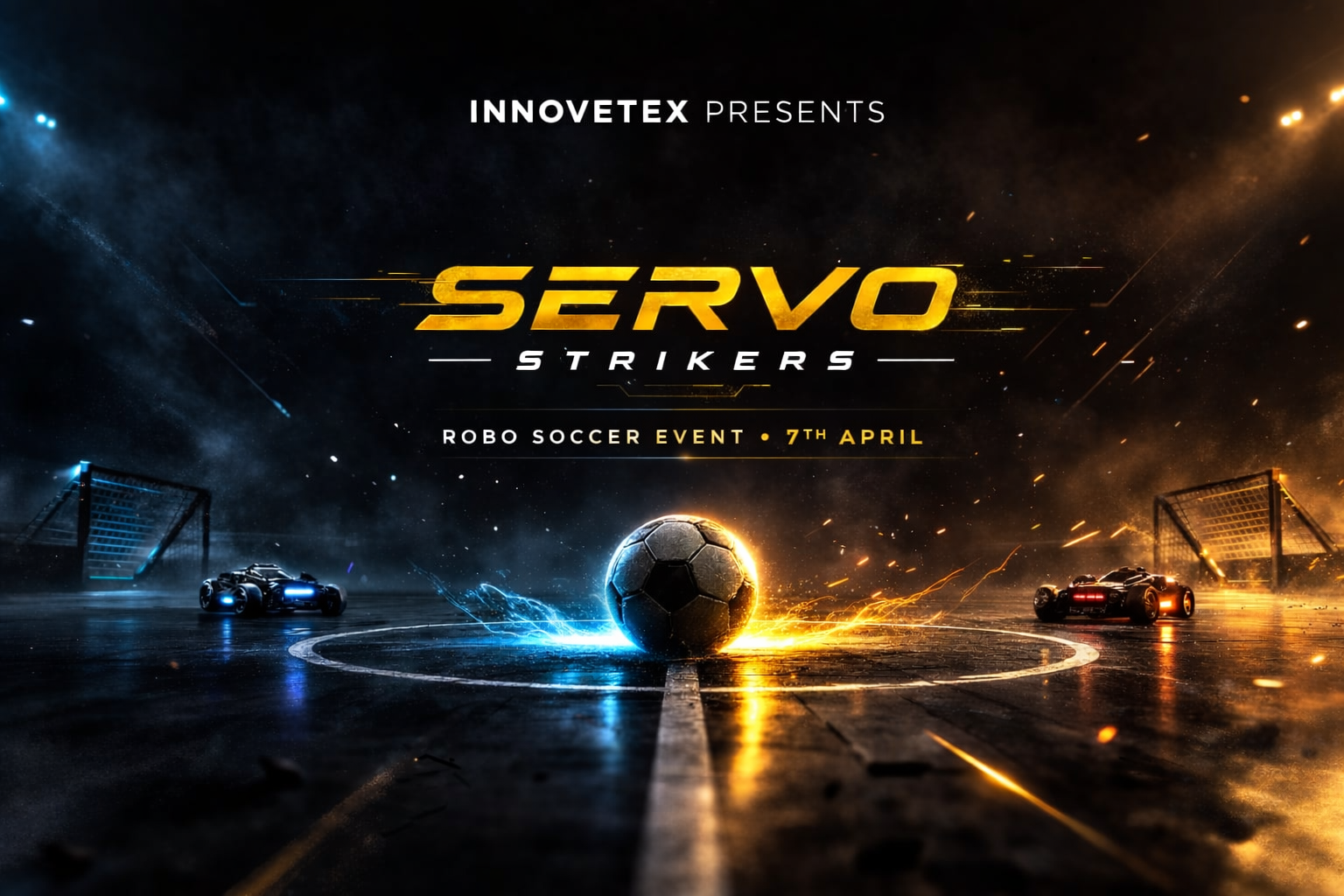
Get ready for the ultimate showdown where rovers rule the pitch! RC Robo Soccer brings the thrill of football into the world of remote-controlled machines, as custom-built rover bots charge, spin, and strike with precision under the command of their operators. These rugged bots aren’t just players—they’re engineered warriors, designed to tackle, dribble, and defend with unstoppable energy. Every match is a spectacle of speed, skill, and strategy, where human reflexes meet mechanical might. Teams battle head-to-head, maneuvering their rovers through intense plays, daring saves, and electrifying goals that ignite the crowd. It’s more than a game—it’s a celebration of creativity, control, and competition, showcasing how innovation transforms play into pure adrenaline. Whether you’re a tech enthusiast or a sports fanatic, RC Robo Soccer promises jaw-dropping action and unforgettable excitement. Watch the rovers roll, the controllers command, and the goals roar!

Market Mavericks is a technology-driven trading simulation designed to replicate real-world stock market decision-making in a risk-free virtual environment. Participants will act as portfolio managers, using virtual capital, analytical tools, and market data to design and execute winning trading strategies.
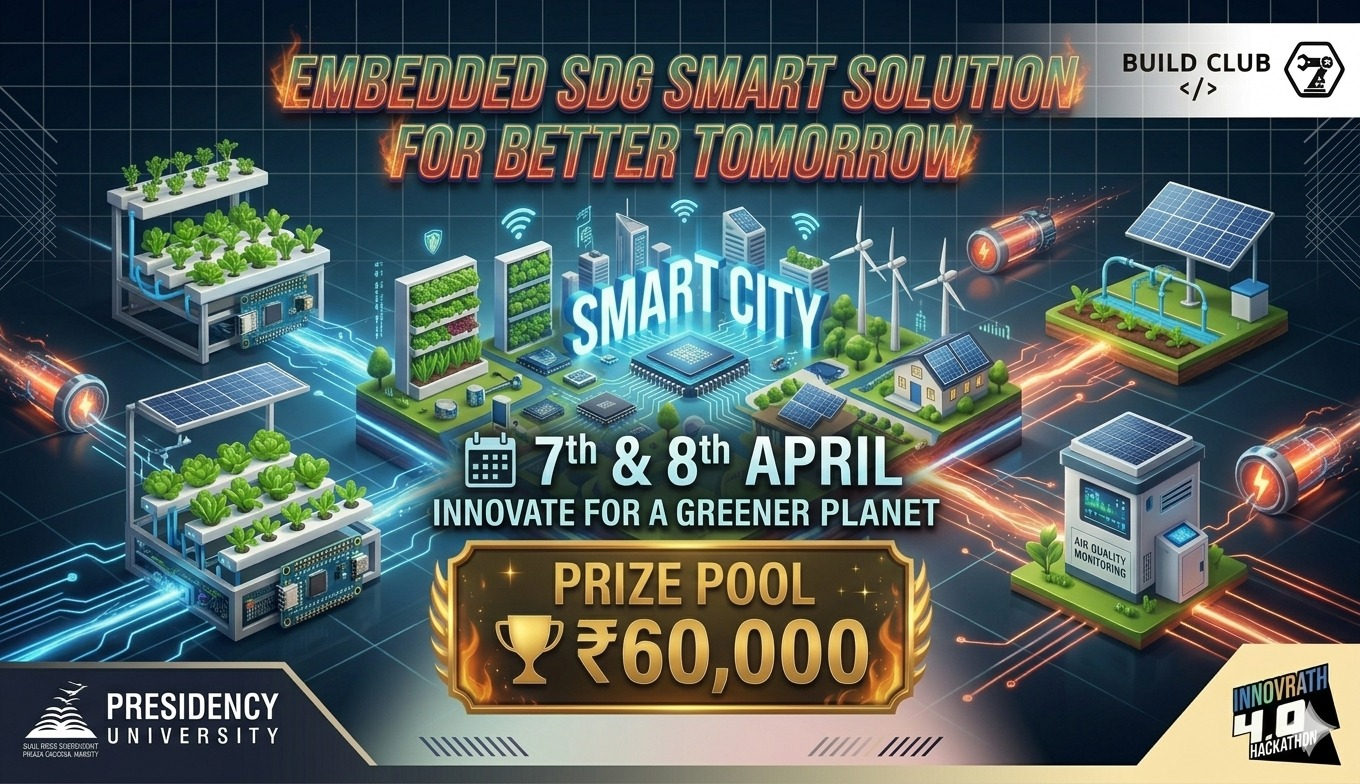
The hackathon will run continuously for 24 hours. All projects must be submitted before the deadline. Late submissions will not be accepted. Theme & Domains The hackathon is focused on projects aligned with the United Nations Sustainable Development Goals (SDGs). Smart Agriculture & Food Security (SDG 2: Zero Hunger) Health & Wearable Technologies (SDG 3: Good Health & Well-Being) Water Conservation & Sanitation (SDG 6: Clean Water & Sanitation) Renewable Energy & Smart Power Management (SDG 7: Affordable & Clean Energy) Smart Infrastructure & Industrial Automation (SDG 9: Industry, Innovation & Infrastructure) Sustainable Cities & Environmental Monitoring (SDG 11: Sustainable Cities & Communities) Climate Action & Wildlife Protection (SDG 13 & SDG 15: Climate Action & Life on Land) Use of Pre-Built Components Participants may use off-the-shelf hardware (e.g., Arduino, Raspberry Pi, sensors). All projects must be developed from scratch during the hackathon. Pre-written code, pre-assembled hardware, or pre-made designs are not allowed and will lead to disqualification. Hardware & Software Rules Hardware Requirements Teams must bring their own hardware components. The organizers will not provide additional components. However, a basic prototyping kit (breadboards, wires, etc.) may be available in limited quantities. Software Development Teams may use open-source libraries and tools. Any usage of pre-built templates must be disclosed during the final presentation. Power & Connectivity The organizers will provide power outlets and basic internet access. Teams are responsible for ensuring their devices are charged and operational throughout the event. Safety Guidelines Participants must follow safety protocols while working with hardware. Projects that pose safety risks (e.g., flammable components, hazardous wiring) will be disqualified. Project Development Rules Teams must strictly follow the assigned domain and present a working prototype. All team members must be actively involved throughout the hackathon. Teams must document their project, including:
A 24 Hour Hackathon Challenge, Our Flagship Event is designed to challenge students on their Product Development Skillset, equipping them with all the required AI tools, API's, and Models, to build a unique working MVP within 24 hours with any theme of their choice.
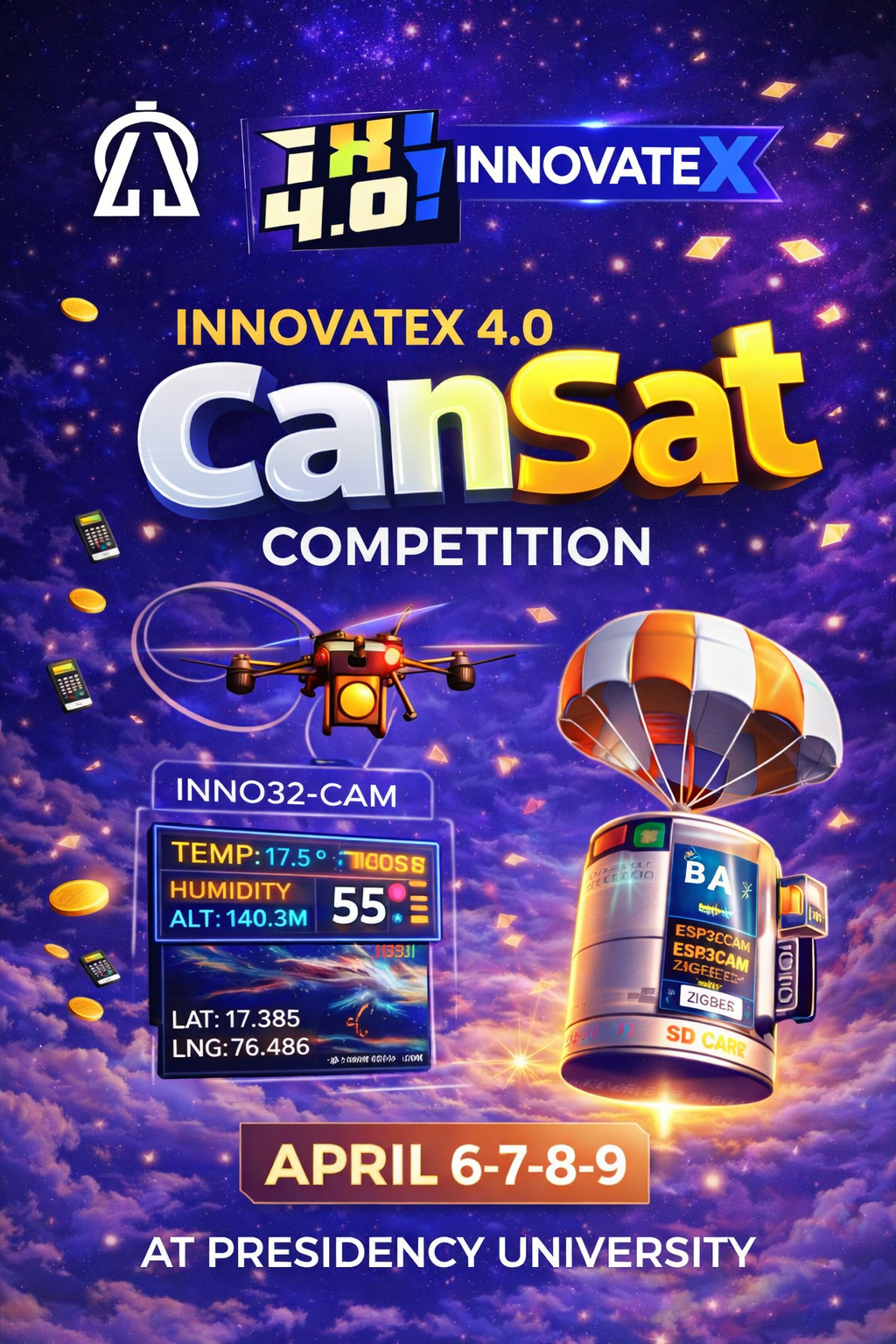
The CANSAT Competition hosted by Presidency University, Bangalore is designed to expose university students to real-world aerospace engineering challenges. The event simulates a complete space mission at a reduced scale, where each team designs, builds, tests, deploys, and analyzes a functional can-sized satellite. This rulebook outlines the competition structure, technical requirements, scoring methodology, safety regulations, and submission standards that teams must follow throughout the event. The objective of the competition is to encourage innovation, practical engineering skills, and teamwork while maintaining strict safety and performance standards. Participants will gain hands-on experience in key areas such as telemetry, avionics, communication protocols, mission planning, and payload design. The competition provides a platform for students to apply theoretical knowledge to practical aerospace engineering problems. All rules stated in this document are binding. Any situations or issues not specifically addressed in the rulebook will be reviewed and resolved by the organizing committee.
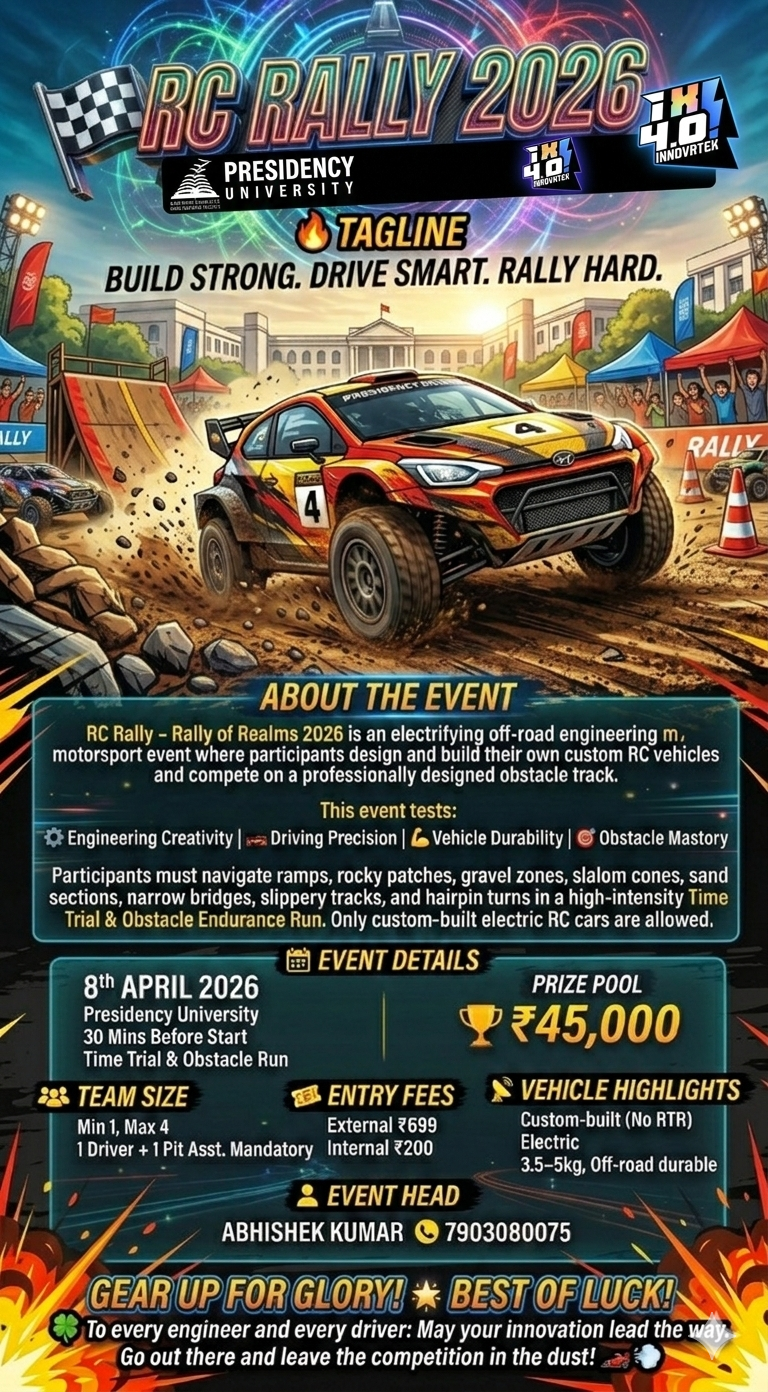
THE ULTIMATE OFF-ROAD CHALLENGE Step into the arena where engineering meets adrenaline. Rally of Realms is not just a race; it’s a grueling test of custom-built machinery and driver nerves. Navigate a professional-grade obstacle course designed to push your creation to its breaking point. The Gauntlet Your vehicle must survive and conquer: ● Rocky Patches & Gravel Zones ● Sand Sections & Slippery Tracks ● Narrow Bridges & Hairpin Turns ● Ramps & Slalom Cones
Tech Myth Busters is an engaging technical challenge where teams compete by testing their knowledge and understanding of technology. Participants analyze common statements related to technology, determine whether they are myths or facts, and explain their reasoning clearly using appropriate technical terms. The event consists of multiple rounds, including Myth Identification, Myth Busting with Explanation, and a Rapid Fire round for the top-performing teams. Each round is designed to evaluate participants’ logical thinking, technical knowledge, ability to explain technical concepts, and decision-making skills. Teams will compete against each other to challenge widely believed technology myths and demonstrate their analytical abilities. The highest-scoring teams will advance to the next rounds and continue competing for the top positions. Tech Myth Busters ultimately serves as a platform for students to apply critical thinking, communicate technical ideas effectively, and showcase their understanding of the technology world.
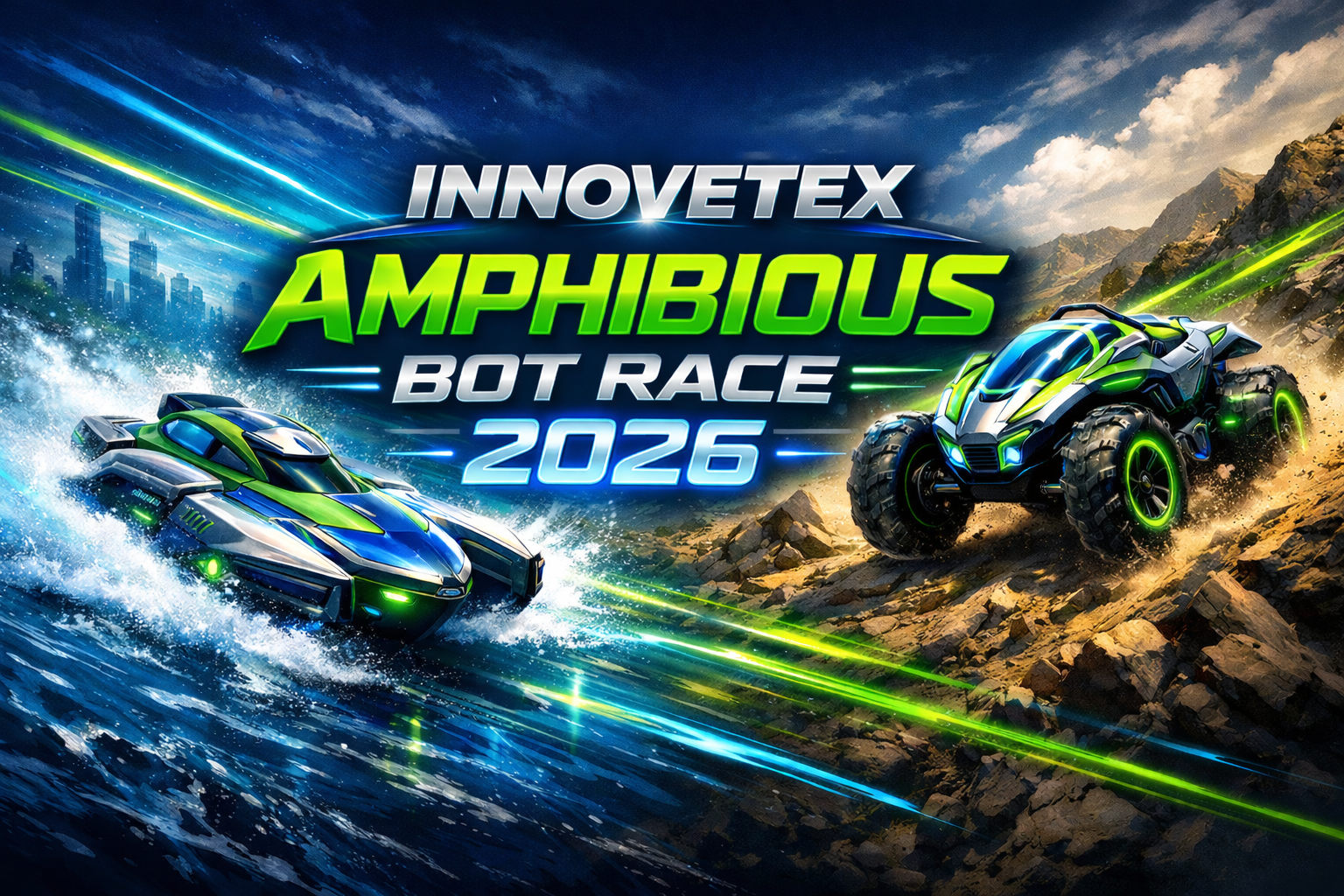
When the world floods and roads crumble… only the bold machines survive.” In a world imagined after chaos—where cities are half-submerged and broken terrain stretches everywhere—the RC Board Water & Land Event becomes more than a race. Teams design remote-controlled boards that can move across cracked land and dangerous water zones, just like explorers navigating the last remaining pathways of Earth. The arena is styled like an apocalyptic landscape: flooded sections, rough tracks, and unpredictable obstacles. Engineering suddenly feels like a story from a sci-fi survival world. Buoyancy keeps the board alive on water, traction fights against rough terrain, and smart design decides who survives the course. Participants become “tech survivors,” guiding their creations through this extreme environment. Some boards may struggle, some may fail dramatically, and a few will dominate both worlds like true post-apocalyptic champions. This event blends imagination with real engineering skills. It shows how innovation can thrive even in the harshest scenarios—because when the world changes, technology adapts.
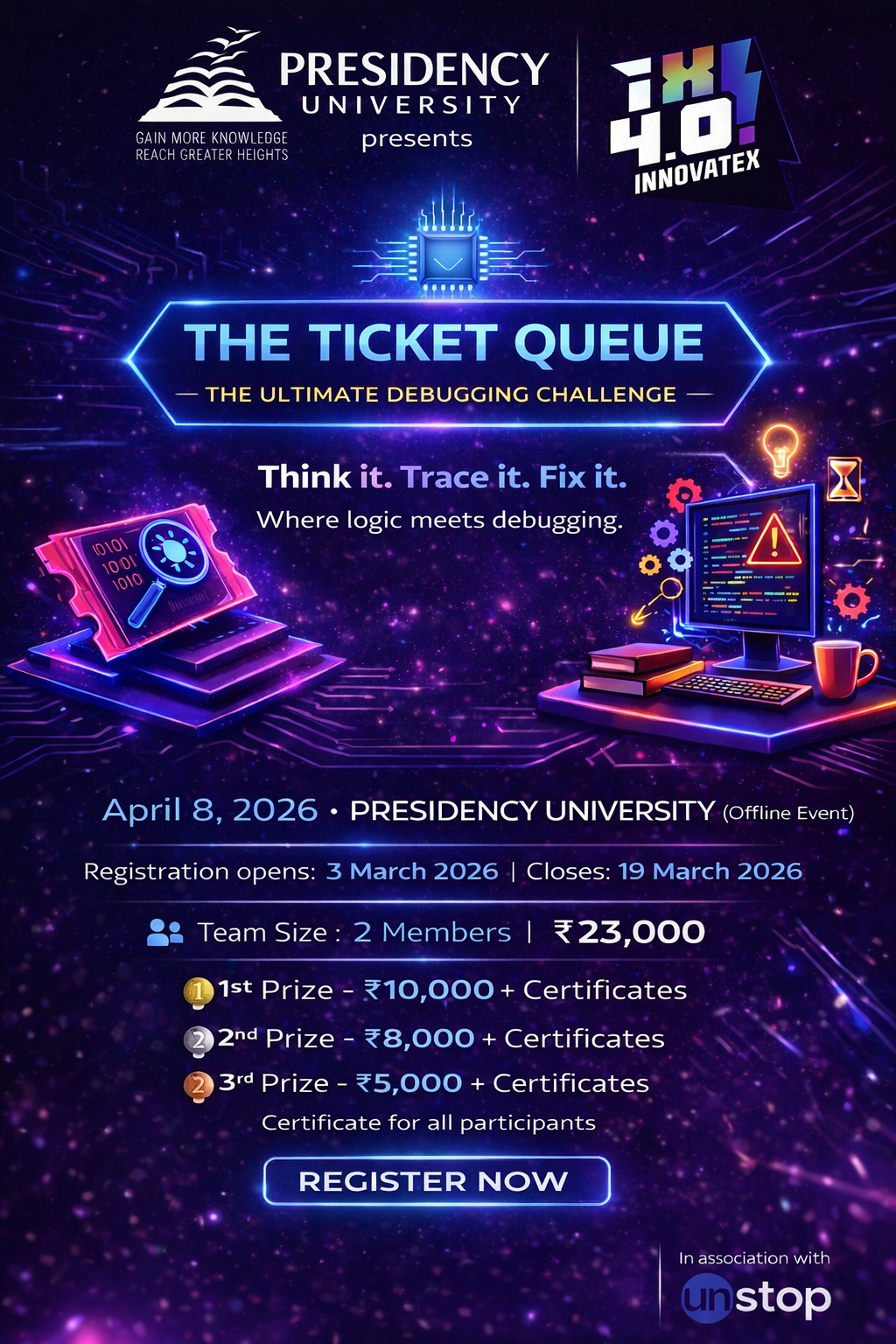
The Ticket Queue is an intensive multi-round debugging challenge designed to test participants’ logical thinking, code analysis, and problem-solving skills. Teams must identify, diagnose, and fix faulty programs while understanding the underlying algorithms behind them. The event simulates real-world software issue resolution systems where participants handle debugging “tickets” through structured reasoning, technical accuracy, and collaborative teamwork across multiple rounds.
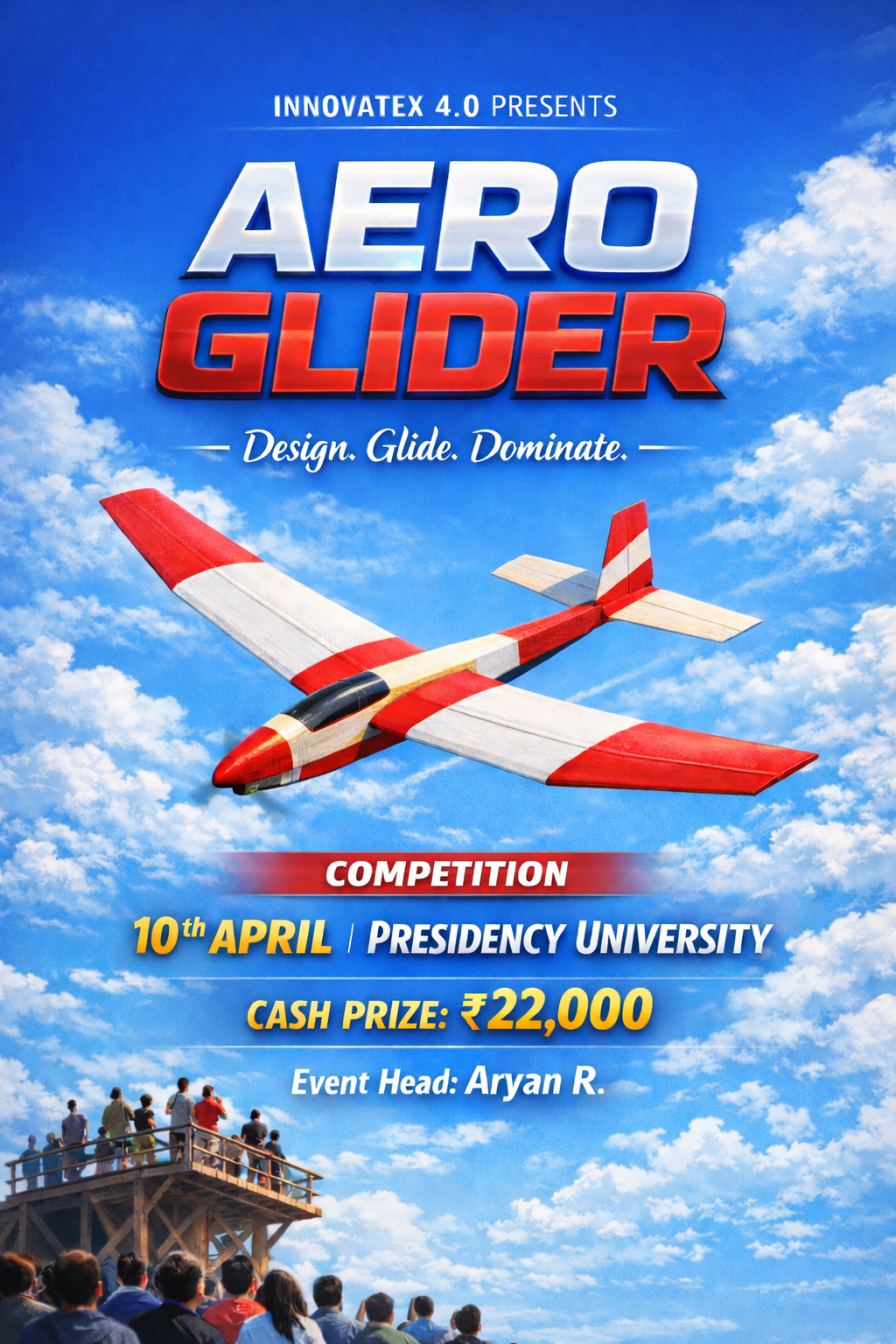
Aero Gliders Challenge Unleash your inner aeronautical engineer! Design, build and launch a glider that soars through the skies. Teams of up to 4 will conceptualise a lightweight fixed-wing model, adhere to material and size constraints, and compete for maximum flight distance, time and design merit. Build something that glides far, flies smoothly and lands reliably. Extra points for design innovation and aesthetics. The winning team will receive the top prize along with recognition at InnovateX 4.0’s closing ceremony. The glider can be made using Depron sheet, balsa wood, foam, and Sun Board. This event is open to all undergraduate participants. The focus is on flight dynamics, creativity, and sound engineering. Join us for a day of flight, fun and friendly rivalry under the banner of the Aero-Club.
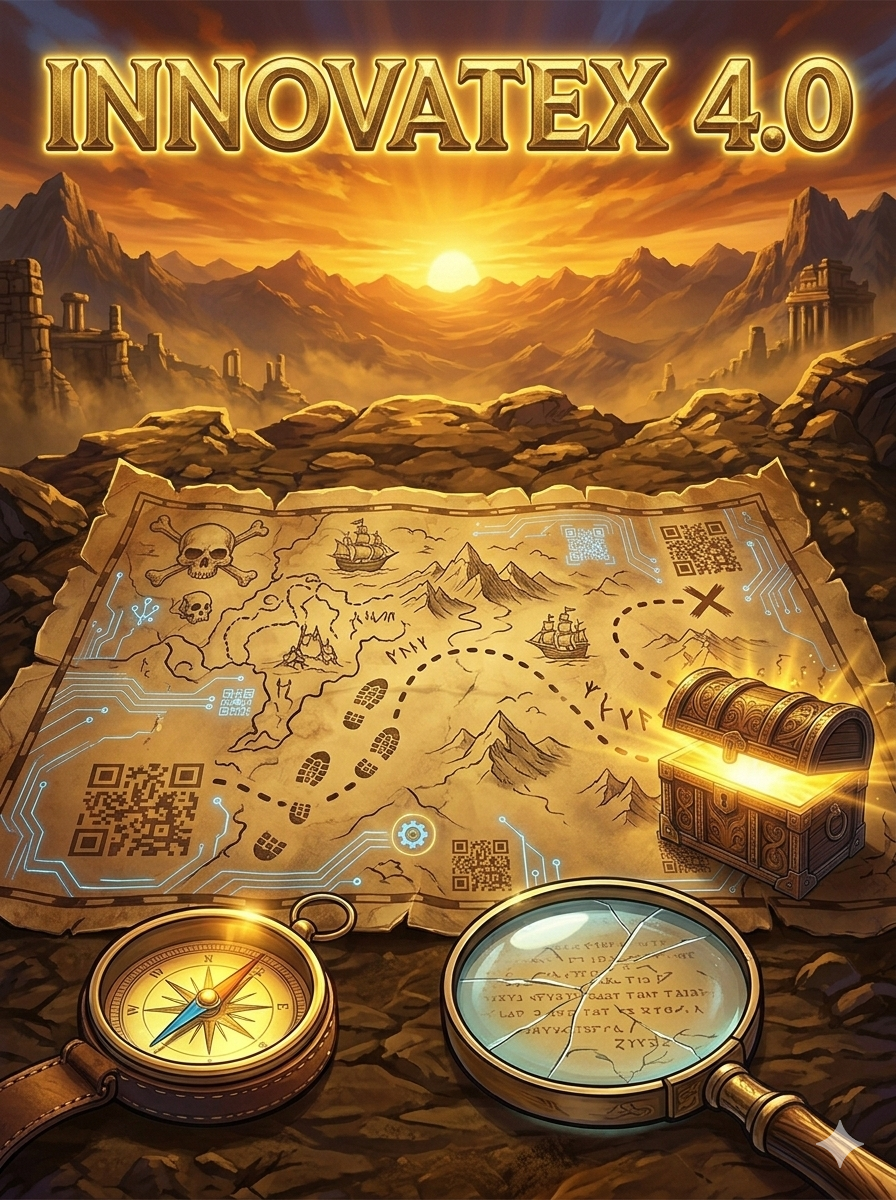
TECH TREASURE HUNT – Code to Clue is a campus-based technical hunt conducted under the MakerSpace Cluster. Participants must decode technical puzzles and codes, where each decoded output reveals a specific campus location. Teams must navigate to that location, collect the hidden physical clue, and proceed to the next stage. The event consists of multiple phases including Registration & Briefing, Clue Hunt, and Technical Challenge Rounds. Clues may include technical riddles, engineering puzzles, QR codes, and logic-based questions. At certain checkpoints, teams must complete small technical tasks such as solving coding logic questions, identifying circuit components, debugging code snippets, or spotting technical errors. Speed, accuracy, and correct clue collection determine the winners. The team that successfully collects all clues and submits them correctly in the final stage will be declared the winner.